About 273 minutes
Nameless River — Edition Insights
Machines Inventions Early Science Fiction
62,741 recorded words. 20 minutes difference from this book's estimate.
View Gutenberg source #63164
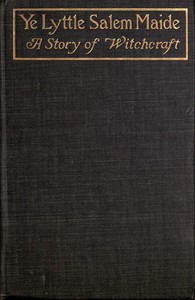
For Ye Lyttle Salem Maide: A Story of Witchcraft — Context and Discussion, the stored edition analysis reports 58,075 words, 4 hr 13 min estimated reading time, and 23 detected text sections.
The text analysis averages about 17.9 words per sentence, while the detected sections provide another way to judge how the source is divided.
Project Gutenberg metadata also associates the work with “Trials (Witchcraft) -- Fiction,” connecting these edition facts with the source record’s subject description.
Explore this collection
These alternatives are selected using recorded categories and estimated reading time.
About 273 minutes
Machines Inventions Early Science Fiction
62,741 recorded words. 20 minutes difference from this book's estimate.
View Gutenberg source #63164About 228 minutes
Machines Inventions Early Science Fiction
52,347 recorded words. 25 minutes difference from this book's estimate.
View Gutenberg source #63947About 285 minutes
Machines Inventions Early Science Fiction
65,365 recorded words. 32 minutes difference from this book's estimate.
View Gutenberg source #64907Search stored excerpts and compare books → Choose by your preferences →
Choices use stored catalog measurements. Estimates vary with reading speed. A shared category is a catalog label, not a claim that two books have the same argument or literary quality.
Search reads excerpt text stored with this catalog and links to its associated Gutenberg record. The connection is stored in the site database; this tool does not recheck that every excerpt is word-for-word identical to that external record. Excerpt search does not cover every chapter and does not verify historical publication dates.
Catalog snapshot checked: 2026-09-26. Coverage: 98 public books, 98 available source excerpts.
Calculated from edition completeness, EPUB availability, text structure and catalogue metadata. Not a user rating.
Total of 100 points, scaled to a 2.5-5.0 range. Editions with an empty description or a missing EPUB file are not scored.
Public-domain source text
The source text is kept in the dedicated reader, separate from this catalogue record and its commentary.
The novel opens with a little Puritan maiden walking an Indian path at twilight, carrying her stockings and shoes—a detail that immediately signals the author's interest in sensory, domestic realism over sensational witchcraft. The child, Abigail Brewster, is unafraid of the forest, and her encounter with a sword-wielding stranger establishes a tone of everyday peril rather than supernatural dread. Mackie's prose lingers on the physical textures of colonial life: starched linen caps, buckled shoon, and the weight of a woolen gown. The catalog subjects list 'Trials (Witchcraft) — Fiction' and 'Salem (Mass.) — History — Colonial period,' but the excerpts show that the trial occupies only a fraction of the narrative; the bulk concerns Abigail's disappearance and the community's anxious routines.
Abigail Brewster is introduced not as a witness to spectral evidence but as a child who 'tripped lightly on, unawed, untroubled' through a forest that adults find menacing. Her disappearance is treated by villagers as the work of 'evil spirits in the guise of Frenchmen and Indians,' yet the narrator shows her 'trudging serenely the path to Boston Town, carrying her shoes and stockings.' This gap between adult hysteria and a child's practical independence is a recurring structural device. The narrative follows Abigail's mundane journey—fordways to cross, petticoat turned up—rather than the courtroom. Mackie uses the child's limited perspective to filter the witch panic, making the supernatural seem less plausible than the simple fact of a girl walking barefoot.
Chapter XII presents Cotton Mather not as a villain but as a man in a 'rarely serene moment,' walking through Salem after a condemnation. The prose describes him noticing 'fruit trees growing adown the street' and setting a fallen child upright—small actions that humanize him while the surrounding text insists that 'to every one else a weight of terror hung like a pall.' Mackie gives Mather an interior monologue about 'trees of emptiness' and a prayer to 'rid this fair, new land of witches,' but she also shows him mechanically pursuing lunch at the tavern. The chapter balances his exalted mood against the villagers' whispered dread, a contrast that suggests the author is more interested in the psychological texture of the crisis than in assigning blame.
Mackie devotes considerable space to the physical atmosphere of Salem under suspicion. In Chapter XII, the sky is 'unnatural' blue, and the villagers long for 'another mighty storm' to justify their fear. A baby is deserted by its 'panic-stricken mother' who believes it possessed. These details—the cry of an infant in swaddling clothes, the 'clumps of shadow on the cobblestone pavement'—build a setting where terror is ambient rather than explicit. The catalog subject 'Trials (Witchcraft)' might lead a reader to expect cross-examinations and spectral testimony, but the excerpts show only one trial scene (for Deliverance) and even that is framed by Mather's satisfaction and the judge's unease. The novel's real subject, based on the available text, is how a community continues its daily duties—knitting on door-stoops, drinking sack at the tavern—while believing evil spirits are abroad.
Readers should approach Ye Lyttle Salem Maide as a period piece that uses the witch trials as a backdrop for a story about childhood, community, and the texture of everyday life in 1692. The excerpts suggest that Mackie is less concerned with the mechanics of the trials than with how ordinary people—children, ministers, judges—navigate a world where the supernatural is assumed to be real. Pay attention to the physical details: the shoes carried, the fruit trees, the baby's cry. These are the evidence from which the novel builds its version of Salem.
Reading Ye Lyttle Salem Maide, I kept thinking how quiet terror is—how it creeps through everyday chores and whispered prayers. It reminded me of the feeling in my old copy of Araminta and the Automobile — Themes and Context, where another girl faces a strange, looming change. Both are about watching your world shift, one step at a time, unsure what comes next. I wonder if that's just growing up.
Build a private reading journal entry for this title.