About 49 minutes
Tennyson — Themes and Context
Machines Inventions Early Science Fiction
11,096 recorded words. 3 minutes difference from this book's estimate.
View Gutenberg source #61764
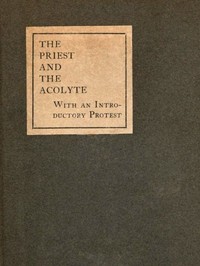
The catalog record for The Priest and the Acolyte With an Introductory Protest by Stuart Mason — Reading Notes provides practical reading context through 10,512 words, 46 min estimated reading time, and 2 detected text sections.
The text analysis averages about 20.8 words per sentence, while the detected sections provide another way to judge how the source is divided.
Project Gutenberg metadata also associates the work with “Catholic Church -- Clergy -- Sexual behavior -- Fiction,” connecting these edition facts with the source record’s subject description.
Explore this collection
These alternatives are selected using recorded categories and estimated reading time.
About 49 minutes
Machines Inventions Early Science Fiction
11,096 recorded words. 3 minutes difference from this book's estimate.
View Gutenberg source #61764About 59 minutes
Machines Inventions Early Science Fiction
13,405 recorded words. 13 minutes difference from this book's estimate.
View Gutenberg source #63009About 171 minutes
Machines Inventions Early Science Fiction
39,193 recorded words. 125 minutes difference from this book's estimate.
View Gutenberg source #58945Search stored excerpts and compare books → Choose by your preferences →
Choices use stored catalog measurements. Estimates vary with reading speed. A shared category is a catalog label, not a claim that two books have the same argument or literary quality.
Search reads excerpt text stored with this catalog and links to its associated Gutenberg record. The connection is stored in the site database; this tool does not recheck that every excerpt is word-for-word identical to that external record. Excerpt search does not cover every chapter and does not verify historical publication dates.
Catalog snapshot checked: 2026-09-26. Coverage: 98 public books, 98 available source excerpts.
Calculated from edition completeness, EPUB availability, text structure and catalogue metadata. Not a user rating.
Total of 100 points, scaled to a 2.5-5.0 range. Editions with an empty description or a missing EPUB file are not scored.
Public-domain source text
The source text is kept in the dedicated reader, separate from this catalogue record and its commentary.
Stuart Mason's introductory protest immediately establishes a contested textual history: the story was originally published in The Chameleon in December 1894, and later misattributed to Oscar Wilde by unscrupulous publishers. Mason quotes Wilde's courtroom dismissal of the tale, framing the narrative that follows as both a literary artifact and a piece of legal evidence. The protest itself shifts from a dry bibliographical note to a detailed account of the Queensberry libel trial, complete with physical descriptions of the Marquis—'short stature, with a round face, and clean shaven except for a streak of red whisker'—and the courtroom atmosphere. This movement from editorial correction to journalistic reportage sets up a pattern of structural juxtaposition that recurs throughout the volume.
The volume's structure is bifurcated: Mason's protest occupies roughly the first third, recounting the trial's proceedings with precise dates and legal details, before the story itself begins. This framing device transforms the fictional narrative into a piece of evidence, a document that was read and debated in court. The protest ends abruptly, and the story opens without transition, as if the reader is now inside the courtroom exhibit. The effect is disorienting: the historical trial and the fictional confession bleed into each other. Within the story, a similar structural doubling occurs—the young priest's confession to his rector mirrors the public trial outside, creating a nested series of judgments. The rector's initial anger and subsequent softening echo the courtroom's shift from accusation to reluctant mercy.
Movement between interior and exterior spaces structures key scenes. The acolyte Wilfred escapes through a window, 'slipped through the window, stole across the grass, and vanished into the opposite cottage.' This threshold crossing—from the priest's room to the outside world—marks a moment of concealment and exposure simultaneously. Earlier, the young priest's confession to the rector occurs 'sitting by the empty grate,' a hearth that offers no warmth, a domestic image rendered sterile. The empty grate recurs as a symbol of failed comfort and spiritual coldness. Windows, doors, and the boundary between the rectory and the cottage become charged spaces where private acts meet public scrutiny. The story's climax hinges on a movement from interior dialogue to exterior action, as the rector's threat to expose the scandal propels the narrative toward its unseen conclusion.
The young priest's defense of his love employs a theological vocabulary that inverts conventional sin language. He asserts, 'There is no sin for which I should feel shame,' and claims his love as a divine gift: 'God gave me my love for him, and He gave him also his love for me.' This rhetorical strategy—claiming divine sanction for a prohibited relationship—echoes the trial's debates about authorship and intention. The rector's response shifts from condemnation to a plea for explanation: 'can you say nothing to defend your crime?' The priest's refusal to defend himself, his insistence that explanation is futile, mirrors the story's own position as a text that refuses to justify itself. The dialogue oscillates between formal accusation and intimate confession, with the priest's voice growing quieter and more abstract as the rector's becomes more agitated.
The story's central confession is truncated: the priest begins to tell his life story, but the narrative breaks off before it concludes. The excerpt ends with his meditation on sin and beauty—'There are vices that are bound to attract almost irresistibly any one who loves beauty above every thing'—leaving the rector's response and the story's resolution unknown. This structural gap is not a flaw but a deliberate withholding. The reader, like the rector, is left with an incomplete account. The trial's own incompleteness—the libel case ended with Wilde's conviction on other charges—echoes this narrative fragmentation. The volume as a whole presents fragments: a protest, a trial transcript, a story, and a missing ending. The gaps invite the reader to consider what is left unsaid, both in the courtroom and in the priest's confession.
Readers approaching this volume should attend to its layered structure: the protest is not merely a preface but a lens through which the story must be read. The trial's language of evidence and judgment inflects every exchange between the priests. The story's truncated confession and its reliance on threshold imagery—windows, grates, doorways—create a geography of exposure and concealment. Rather than seeking a complete narrative, consider how the gaps and silences function as part of the work's meaning. The volume is as much about what cannot be said as what is spoken aloud.
I have often paused over that old protest—how a story's quiet ache, its burden of being misread, lingers like dust in a chapel. It reminds me of Araminta and the Automobile — Themes and Context, where another kind of wandering finds its own unhurried pace. Both keep their secrets close, waiting for a patient hand.
Answer a few questions and save a private reflection on this device.