About 374 minutes
The Markenmore Mystery — Context and Discussion
Machines Inventions Early Science Fiction
85,794 recorded words. 19 minutes difference from this book's estimate.
View Gutenberg source #59818
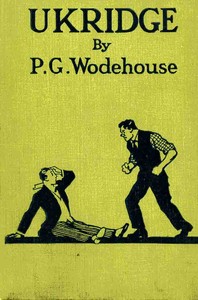
The catalog record for Ukridge — Background and Themes provides practical reading context through 81,564 words, 5 hr 55 min estimated reading time, and 9 detected text sections.
The text analysis averages about 13.9 words per sentence, while the detected sections provide another way to judge how the source is divided.
Project Gutenberg metadata also associates the work with “Humorous stories,” connecting these edition facts with the source record’s subject description.
Explore this collection
These alternatives are selected using recorded categories and estimated reading time.
About 374 minutes
Machines Inventions Early Science Fiction
85,794 recorded words. 19 minutes difference from this book's estimate.
View Gutenberg source #59818About 329 minutes
Machines Inventions Early Science Fiction
75,599 recorded words. 26 minutes difference from this book's estimate.
View Gutenberg source #63939About 309 minutes
Machines Inventions Early Science Fiction
70,868 recorded words. 46 minutes difference from this book's estimate.
View Gutenberg source #65076Search stored excerpts and compare books → Choose by your preferences →
Choices use stored catalog measurements. Estimates vary with reading speed. A shared category is a catalog label, not a claim that two books have the same argument or literary quality.
Search reads excerpt text stored with this catalog and links to its associated Gutenberg record. The connection is stored in the site database; this tool does not recheck that every excerpt is word-for-word identical to that external record. Excerpt search does not cover every chapter and does not verify historical publication dates.
Catalog snapshot checked: 2026-09-26. Coverage: 98 public books, 98 available source excerpts.
Calculated from edition completeness, EPUB availability, text structure and catalogue metadata. Not a user rating.
Total of 100 points, scaled to a 2.5-5.0 range. Editions with an empty description or a missing EPUB file are not scored.
Public-domain source text
The source text is kept in the dedicated reader, separate from this catalogue record and its commentary.
Stanley Featherstonehaugh Ukridge, as presented in these pages, is a man perpetually on the verge of a fortune. The opening chapter finds him proposing a biography to the narrator, offering to split proceeds from a life he considers rich material. His schemes—a dog college, an accident syndicate, backing a tender-hearted pugilist—unfold with a pattern of grand plans, borrowed money, and inevitable collapse. The humor derives not from success but from the gap between Ukridge's boundless confidence and the absurd realities he creates.
The excerpts reveal a distinctive voice: Ukridge addresses the narrator as “laddie” or “old horse,” pockets borrowed tobacco, and renegotiates deals mid-sentence. His friend Hank Philbrick, discovered at 2 a.m. outside a fishing tackle shop, smoking two cigars while sitting on the pavement with his hat on his foot, exemplifies the kind of character Ukridge attracts. The stories are less about plot than about the texture of these encounters and the resilience of Ukridge's optimism.
The excerpts establish Ukridge through his speech and actions. He calls the narrator “son of Belial” and “old horse,” mixes flattery with casual appropriation—helping himself to tobacco while slipping the pouch into his own pocket. His proposals are always urgent and always involve splitting hypothetical proceeds. When the narrator questions his finances, Ukridge instantly revises his offer: “Well, then, I'll make it my share of the English and American serial rights for fifty.” This flexibility is not generosity but a reflex; Ukridge treats money as a fluid concept, adjusting figures to match the moment's need.
His physical descriptions reinforce the impression. The narrator notes his collar “come off its stud,” a detail that suggests perpetual dishevelment. Ukridge's world is one of late-night encounters, borrowed funds, and schemes that never quite materialize. The dog college, mentioned in the story summary, is never described in the excerpts, but the pattern is clear: Ukridge counts his chickens before they are hatched, and the hatching never arrives.
The encounter with Hank Philbrick, a man who has recently come into money, offers a concentrated example of Ukridge's methods. Philbrick is discovered at nearly 2 a.m., sitting on the pavement with his back against a lamp-post, his hat on his left foot, smoking two cigars. Ukridge explains that Philbrick has taken up mixing liqueurs—“benedictine, chartreuse, kummel, crème de menthe, and old brandy”—in tankards, a hobby that leaves him “a bit under the weather.”
Ukridge positions himself as Philbrick's only London friend, accompanying him nightly. The narrator observes that Philbrick tipped the night-porter twenty pounds, confirming his reckless spending. Ukridge is acting as agent for Philbrick's house purchase, and the narrator concludes that “Ukridge would undoubtedly make enough out of his share of the commission to pay off Dora Mason's hundred without feeling it.” This is the first mention of Dora Mason, a character whose significance remains unclear from the excerpts. The episode highlights Ukridge's ability to attach himself to those with money, even as their behavior grows increasingly erratic.
The book is organized as a series of chapters, each titled after a scheme: “Ukridge's Dog College,” “Ukridge's Accident Syndicate,” “The Début of Battling Billson,” and so on. The table of contents lists ten chapters, suggesting a episodic structure where each scheme occupies one or two chapters. The narrator, referred to as “I” in the excerpts, appears to be a writer and friend who observes Ukridge's exploits. He is not a passive recorder; he retrieves his tobacco pouch, questions Ukridge's plans, and helps carry Philbrick to the Carlton. His voice is wry and slightly exasperated, providing a counterpoint to Ukridge's relentless enthusiasm.
The story summary at the beginning states that “hope and George Tupper keep Ukridge going,” introducing a second friend who may play a role in later chapters. The excerpts do not show George Tupper, but his presence is promised. The narrative frame—a friend chronicling a charismatic schemer—recalls other Wodehouse works, but here the focus is squarely on Ukridge's schemes and their immediate, often farcical consequences.
The excerpts offer a vivid introduction to Ukridge's world, but they leave many questions unanswered. What is the dog college, and how does it fail? Who is Dora Mason, and what is the hundred pounds she is owed? The reader is encouraged to attend to the rhythm of Ukridge's speech, the reactions of his friends, and the small details—a collar stud, a borrowed pouch, a hat on a foot—that define his character. The humor lies not in the outcome of each scheme but in the energy Ukridge brings to the attempt, and in the patience of those who, despite everything, continue to help him.
Reading about Ukridge’s doomed schemes, I remembered my own uncle’s chicken farm—how his certainty outshone every failure. That same warm, frayed optimism lives in The Gaspards of Pine Croft: A Romance of the Windermere — Context and Discussion, where hope clings to a crumbling house. Some characters simply cannot stop building castles, and I find that heartbreakingly lovely.
A brief reflection can help important ideas stay with you longer.