About 228 minutes
Rue and Roses — Text and Context
Machines Inventions Early Science Fiction
52,347 recorded words. 15 minutes difference from this book's estimate.
View Gutenberg source #63947
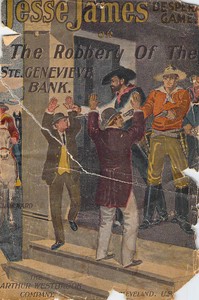
This digital edition of Jesse James' Desperate Game; Or, The Robbery of the Ste. Genevieve Bank — Background and Themes is described by source-level measurements including 48,932 words, 3 hr 33 min estimated reading time, and 6 detected text sections.
The text analysis averages about 17.7 words per sentence, while the detected sections provide another way to judge how the source is divided.
Project Gutenberg metadata also associates the work with “Western stories,” connecting these edition facts with the source record’s subject description.
Explore this collection
These alternatives are selected using recorded categories and estimated reading time.
About 228 minutes
Machines Inventions Early Science Fiction
52,347 recorded words. 15 minutes difference from this book's estimate.
View Gutenberg source #63947About 253 minutes
Machines Inventions Early Science Fiction
58,075 recorded words. 40 minutes difference from this book's estimate.
View Gutenberg source #62815About 171 minutes
Machines Inventions Early Science Fiction
39,193 recorded words. 42 minutes difference from this book's estimate.
View Gutenberg source #58945Search stored excerpts and compare books → Choose by your preferences →
Choices use stored catalog measurements. Estimates vary with reading speed. A shared category is a catalog label, not a claim that two books have the same argument or literary quality.
Search reads excerpt text stored with this catalog and links to its associated Gutenberg record. The connection is stored in the site database; this tool does not recheck that every excerpt is word-for-word identical to that external record. Excerpt search does not cover every chapter and does not verify historical publication dates.
Catalog snapshot checked: 2026-09-26. Coverage: 98 public books, 98 available source excerpts.
Calculated from edition completeness, EPUB availability, text structure and catalogue metadata. Not a user rating.
Total of 100 points, scaled to a 2.5-5.0 range. Editions with an empty description or a missing EPUB file are not scored.
Public-domain source text
The source text is kept in the dedicated reader, separate from this catalogue record and its commentary.
William Ward's Jesse James' Desperate Game; Or, The Robbery of the Ste. Genevieve Bank (1906) opens not with a holdup but with a panoramic view of Monegaw Springs, a Missouri resort where "convention was thrown to the winds" and strangers mingle freely. This setting establishes a pattern: the narrative repeatedly moves between open, public spaces—springs, roads, yards—and enclosed, private ones—houses, kitchens, halls. The bank robbery itself, though promised in the title, is deferred; the excerpts instead dwell on the cat-and-mouse game between Jesse's gang and a posse of detectives, with much of the action occurring in farmhouses and domestic interiors. Ward's prose relies on a handful of recurring devices—stifled coughs, latches, lanterns—to generate suspense, and the structure favors extended standoffs over rapid action.
The novel's geography is defined by a stark contrast between outdoor assembly and indoor concealment. The opening chapter lingers on the Springs' transient population, where "all sorts and conditions of men" mix without introduction. Yet once the pursuit begins, the action retreats indoors. The Prior farmhouse becomes a stage for a prolonged bluff: Mrs. Prior stalls at the door, her daughter Marjorie slips inside to hide the outlaws, and the detectives demand lanterns to search. Ward uses doorways as thresholds of tension—each latch lifted or cough heard shifts the balance of power. The yard remains a space of waiting, where four man-hunters stand guard while their colleagues ransack rooms. This oscillation between exposure and enclosure gives the narrative a rhythmic, almost theatrical quality.
A single stifled cough near the end of Chapter IX triggers a cascade of suspicion. When Jones places his hand on the latch, the sound freezes the detectives: "That was a signal," one hisses, and they suddenly fear an ambush inside the house. Ward deploys this auditory cue with precision—the cough is never explained, but its effect is immediate. Earlier, Mrs. Prior's verbal bluffs (claiming her husband bought horses from miners) fail because Ephraim's silence gives her away. The cough, by contrast, works because it is involuntary and ambiguous. It belongs to no named character and could be accidental or deliberate. Ward trusts the reader to infer that the outlaws are hidden nearby, but he withholds confirmation, letting the sound do the work of suspense. This is a lean, effective technique in a novel that otherwise relies on dialogue-heavy standoffs.
Light sources are scarce in the Prior farmhouse scenes. The detectives demand lanterns to search, but Mrs. Prior refuses to provide them without supervision, forcing the man-hunters to proceed in dimness. Ward uses this lack of illumination to create uncertainty: the searchers cannot see clearly, and the reader cannot see what they miss. When Jones hears the cough, he hesitates at the door, unsure whether the darkness hides an ambush. Later, in Chapter X, the Prior family's inexplicable grins unnerve the detectives further—their faces are visible, but their motives are not. The lantern thus becomes a symbol of failed detection: the hunters have light but not insight. Ward's handling of visual obstruction is consistent; he prefers to keep both characters and readers in partial darkness, heightening the sense of a game played by feel rather than sight.
Despite the title's emphasis on the Ste. Genevieve bank robbery, the excerpts focus almost entirely on the pursuit, not the crime. The robbery itself is mentioned only in the subtitle and chapter list; the actual text devotes pages to the Prior farmhouse standoff. This structural choice suggests that Ward is less interested in the heist than in the chase and the narrow escapes. The chapter titles promise action—"The Dash for Liberty," "The Storm Breaks"—but the prose lingers on negotiation and bluff. Even the pistol shots mentioned in the opening description of Monegaw Springs are attributed to drunken wrangling, not outlaw violence. Ward's method is to delay gratification: the reader waits for the robbery while the narrative circles around it. This deferral creates a peculiar tension, as if the book itself is playing a desperate game with its own plot.
Readers approaching Jesse James' Desperate Game should expect a story that values standoffs over shootouts and dialogue over action. Ward's structural choices—the movement from open resort to closed farmhouse, the reliance on coughs and lanterns as suspense mechanisms, the postponement of the titular robbery—reveal a writer more interested in the mechanics of pursuit than in the crime itself. The novel rewards attention to small details: a latch lifted, a grin exchanged, a sound in the dark. These are the threads that hold the chase together.
That rainy afternoon, I kept returning to how Ward’s lanterns and half-open doors built dread through sheer repetition, the same gesture used until it felt like a held cough. It made me wonder about narrative mechanics themselves, which is how I landed on A History of Story-telling: Studies in the development of narrative — Key Ideas to Explore. That older book speaks to the same quiet patience, the craft of pattern over plot.
Create a short personal record of your experience with this book.