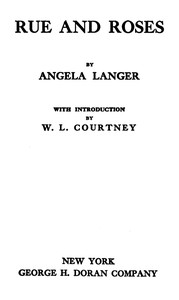
Angela Langer's Rue and Roses opens with an introduction by W. L. Courtney that frames the heroine, Anna, as intensely Teutonic and self-analytic, a young woman who has "ceaselessly occupied herself with her own soul-states." The novel itself begins in medias res with Anna's return to her family after a failed governess post, immediately establishing a tone of economic anxiety and emotional isolation. The excerpts show a first-person narrator who measures her worth in mended blouses and new belts, and who revisits childhood haunts under cover of darkness. The prose is direct, unadorned, and tightly focused on Anna's inner life and material circumstances.
A Heroine Defined by Introspection and Poverty
Courtney's introduction warns that Anna may strike readers as "fragmentary" and "a little priggish and pedantic," but the excerpts bear out a more sympathetic portrait. Anna's self-analysis is not abstract philosophizing but a practical response to chronic instability: her father's failed businesses, a brother who is "a severe affliction," and a mother "always on the verge of tears." The narrative voice is precise about money—"a new pair of boots was once more a tempting suggestion"—and about the social shame of her father having been in prison. The reader is given access to Anna's thoughts as she weighs a job offer from a former employer, Mr. Sandor, whose letter arrives with a "Hungarian stamp, showing the sloping cross and above it the flying eagle." Her hesitation is not coyness but a realistic assessment of limited options.
The Weight of Material Details
Langer builds character through objects and their care. When Anna decides to accept the Sandor position, she does not simply pack; she examines each garment: "If that blouse, I thought, received a new pair of sleeves it might do quite well at home; and if I sewed a new belt on that skirt, it would not look so bad." This attention to mending and repurposing is not decorative—it signals a life where every item must be stretched. The narrative lingers on the physical act of preparation: "I put aside piece after piece, and decided to start with the mending at once." Such passages ground Anna's emotional life in tangible scarcity, making her later visions of flames and exclusion feel earned rather than melodramatic.
Landscape as Emotional Geography
The evening before her departure, Anna walks through her hometown, visiting sites that hold memory. The church square "had not altered," but the corner where her flowers once grew now holds "a kennel, and a large bushy dog darted at me distrustfully." The graveyard, once feared, becomes a place of solace: "to-day my heart was filled with such sadness that all other feelings were overcome by it." Langer uses these familiar landmarks to chart Anna's changing inner state. The walk is a ritual of leave-taking, and the prose remains restrained, letting the contrast between past and present—flowers replaced by a dog, fear replaced by sadness—carry the emotional weight.
The Vision of Exclusion
At the graveyard wall, Anna has a striking vision: "a circle of flames, growing into enormous size, embracing all the world except myself, leaving me outside and alone." This image, occurring roughly midway through the excerpts, crystallizes the novel's central tension between belonging and isolation. The flames are not hellfire but a boundary; they encompass everyone but her. The passage is brief and unelaborated, typical of Langer's understated style. It does not explain itself, leaving the reader to connect it to Anna's earlier sense of being "scorned and avoided ever since I was a child." The vision is a moment of symbolic clarity in a narrative otherwise anchored in the concrete.
Readers approaching Rue and Roses should attend to the interplay between Anna's inner life and her material world. The novel's power lies not in dramatic incident but in small, precise observations—a mended belt, a distrustful dog, a letter with a Hungarian stamp. The first-person narration invites intimacy but also demands patience; Anna's self-analysis can feel circular, but it is always grounded in specific circumstances. The excerpts suggest a work that rewards close attention to its quiet, cumulative detail.
Anna’s torn longing in Rue and Roses always felt like a hush in lamplight, a soul weighing its own quiet hungers. Years later, I still recall that ache when turning to The Gaspards of Pine Croft: A Romance of the Windermere — Context and Discussion, where another house holds its breath. Both speak of wanting, without ever raising their voices.