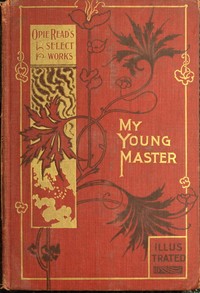
Opie Read's My Young Master opens with a striking formal choice: the story of a master is told by his slave. The narrator, Dan, begins by looking back from an unspecified later time, watching 'pictures in the fire' of his Kentucky boyhood. He worries that his 'rude hand' cannot do justice to the tale, yet trusts that 'truth alone' will carry it. This framing immediately establishes a double perspective—the events as they felt to a child in bondage, and the mature understanding of a man who has lived through emancipation.
The first chapter introduces the Gradley farm, its boundary line with the town of Litchford, and the social hierarchy among enslaved people, where belonging to a prominent master conferred a kind of status. Dan recalls a boy weeping because his master lived in a log house. Such details signal that the novel will examine not only the cruelty of slavery but also its internal gradations and the strange pride that could coexist with oppression.
A Narrator Between Two Worlds
Dan's voice is the novel's central achievement. He speaks as a former slave, but his language is not uniformly 'crude' as he fears—it is measured, reflective, and capable of sharp irony. He describes his young master as 'Mars. B' and refers to 'Old Master' and 'Old Miss' with a mixture of affection and resentment. The narrative is punctuated by moments of intense emotion: the sight of the doctor is 'iced water constantly dripping upon my head.' Dan does not claim to be fearless; he admits to trembling when spoken to, and he hides behind stone walls to avoid the doctor. Yet he also confesses that he would have gladly fought the man and could have 'cut his throat.' This tension between fear and fury, submission and rebellion, runs through every scene.
The excerpts show Dan's careful observation of social codes. He knows that standing behind his master's chair at meals is 'a piece of nonsense,' but he also knows that defying Old Miss will bring trouble. When his young master tells him to stop, Dan obeys—but only until Old Miss forces him back. These small negotiations reveal the constant calculation required for survival.
The Doctor as a Figure of Unrelenting Threat
The doctor, Old Miss's son-in-law, emerges as the primary antagonist in the supplied text. He is described with visceral imagery: his eyes are 'green with hate,' and Dan imagines him thrusting forth 'a forked tongue like a serpent.' The doctor's cruelty is not abstract; it is embodied in a riding whip and a command to drink whisky. He tells the distiller that 'an apple tree sprout well laid on would add many a dollar to his worth,' reducing Dan to a commodity whose value can be increased by beating.
The confrontation on the road is the most dramatic scene in the excerpts. The doctor orders Dan to drink from the jug, intending to bring disgrace upon him and his young master. Dan refuses, and when the whip is raised, he speaks in a 'sharp tone' that makes the doctor pause. This moment of defiance is brief—the doctor hisses 'Do you threaten me!'—but it marks a shift. Dan has crossed a line, and the reader senses that the conflict will escalate. The doctor's age, which had 'eluded the notice of age,' suddenly catches up with him, wrinkling his face. The physical detail suggests that Dan's resistance has, for an instant, exposed the man's vulnerability.
The Social Geography of Bondage
Read builds the world of the Gradley farm through specific, concrete details. The boundary line between the farm and Litchford is a recurring motif—Dan and his young master search for it as children, parting the long grass. This line is both literal and symbolic: it marks the edge of the master's property, the limit of Dan's known world, and the point where town and country meet. The church bells ring on Sunday, and Old Master and Old Miss walk past the boys on their way to town, a casual image of authority.
The distillery scene adds another layer: the distiller, a white man of lower status, joins the doctor in appraising Dan's worth. 'He'd be worth fifteen hundred if he was a little pearter,' the distiller says, treating Dan as livestock. The casualness of the exchange is chilling. Dan's response—to walk rapidly, to avoid eye contact, to calculate the doctor's movements—shows how enslaved people had to read the landscape and the moods of white people constantly. The novel, even in these fragments, conveys the texture of a system where every interaction carried the threat of violence.
Readers should attend to the gaps in the excerpts: the full arc of Dan's relationship with his young master, the fate of the doctor, and the outcome of the confrontation on the road are not revealed here. The novel's title, My Young Master, suggests a bond that is both intimate and hierarchical, and the first-person narration invites the reader to see slavery from inside a single consciousness. Pay attention to moments when Dan's voice shifts—when he speaks of 'truth alone' or recalls the 'sad and a happy freak' of the old days. These are the hinges on which the story turns.
Reading My Young Master, I kept thinking about the quiet weight of devotion that outlives its original conditions—how tenderness can survive cruelty. It reminded me, strangely, of the atmosphere around The Priest and the Acolyte With an Introductory Protest by Stuart Mason — Reading Notes. Both feel like whispered confessions, told late at night, where the room’s shadows hold the secrets better than any page.