About 309 minutes
Pastorals of Dorset — Background and Themes
Machines Inventions Early Science Fiction
70,868 recorded words. 20 minutes difference from this book's estimate.
View Gutenberg source #65076
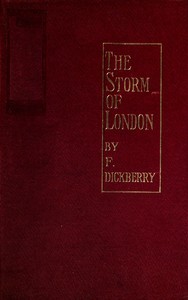
The catalog record for The storm of London: a social rhapsody — Background and Themes provides practical reading context through 75,599 words, 5 hr 29 min estimated reading time, and 23 detected text sections.
The text analysis averages about 21.3 words per sentence, while the detected sections provide another way to judge how the source is divided.
Project Gutenberg metadata also associates the work with “Science fiction,” connecting these edition facts with the source record’s subject description.
Explore this collection
These alternatives are selected using recorded categories and estimated reading time.
About 309 minutes
Machines Inventions Early Science Fiction
70,868 recorded words. 20 minutes difference from this book's estimate.
View Gutenberg source #65076About 355 minutes
Machines Inventions Early Science Fiction
81,564 recorded words. 26 minutes difference from this book's estimate.
View Gutenberg source #61507About 303 minutes
Machines Inventions Early Science Fiction
69,502 recorded words. 26 minutes difference from this book's estimate.
View Gutenberg source #62129Search stored excerpts and compare books → Choose by your preferences →
Choices use stored catalog measurements. Estimates vary with reading speed. A shared category is a catalog label, not a claim that two books have the same argument or literary quality.
Search reads excerpt text stored with this catalog and links to its associated Gutenberg record. The connection is stored in the site database; this tool does not recheck that every excerpt is word-for-word identical to that external record. Excerpt search does not cover every chapter and does not verify historical publication dates.
Catalog snapshot checked: 2026-09-26. Coverage: 98 public books, 98 available source excerpts.
Calculated from edition completeness, EPUB availability, text structure and catalogue metadata. Not a user rating.
Total of 100 points, scaled to a 2.5-5.0 range. Editions with an empty description or a missing EPUB file are not scored.
Public-domain source text
The source text is kept in the dedicated reader, separate from this catalogue record and its commentary.
Fernande Blaze de Bury’s The Storm of London: A Social Rhapsody opens with a premise as audacious as its subtitle suggests: a supernatural tempest that strips every inhabitant of the city of their clothes, leaving them physically naked but also socially exposed. The novel does not dwell on the mechanics of the storm; instead, it immediately turns to the conversational aftermath, where characters like Lady Carey, Danford, and Montagu Vane debate the implications of nudity in a drawing-room setting. The dialogue is sharp, laced with irony and philosophical jabs, as when Danford likens society to a ‘huge spectrum reflecting all sorts of coloured shapes’ that shatter when the lens is struck. This early exchange establishes the book’s central tension: the conflict between the desire for social order and the chaotic freedom of a clothesless world.
The excerpts reveal that Blaze de Bury’s primary tool is dialogue, not descriptive narration. Characters speak in long, epigrammatic turns that recall Oscar Wilde’s drawing-room comedies, but with a more earnest philosophical edge. Lady Carey’s complaint that ‘everything is so uniform, the days so long, the amusements so scarce’ after the storm is both a lament and a satirical jab at the monotony of high society. Danford’s retort—that society is a ‘phantasmagoria’ that vanishes when broken—serves as a thesis for the novel’s social critique. The conversation is layered with double meanings: when Lady Carey asks about ‘the science of observation,’ she refers to the new necessity of recognizing people without their usual markers of status. This verbal sparring is not mere banter; it is the mechanism by which the author dissects the artificiality of class distinctions.
One of the most striking passages is Montagu Vane’s proposal to invent ‘a sort of artificial vestment’ using small electric batteries that ‘would throw a lovely colour all over one’s body.’ This idea, presented in a London drawing-room as a serious solution, underscores the novel’s satirical tone. The characters are so wedded to the concept of adornment that they immediately seek to replace clothing with technology, even as they acknowledge the absurdity of discussing nudity openly. The line ‘a few weeks ago no respectable person would have admitted the existence of shirt or trousers’ highlights the sudden inversion of social taboos. Blaze de Bury uses this moment to mock the British cant that Lionel decries, suggesting that the storm has merely exposed pre-existing hypocrisies. The electric battery scheme is a perfect emblem of the novel’s blend of science fiction and social comedy.
Throughout the excerpts, the physical state of nudity is less important than its social consequences. The characters are preoccupied with how to maintain hierarchy without clothes. Lady Carey’s remark that ‘Society would crumble away’ if people stopped attending plays reveals the fragility of social structures. Danford’s observation that Mrs Webster ‘cannot remember more than half-a-dozen faces’ points to the difficulty of recognizing people without their uniforms of dress. The novel suggests that clothing was not merely decorative but essential to the performance of identity. By removing it, the storm forces characters to confront the arbitrary nature of their distinctions. The dialogue repeatedly circles back to the idea that society is a collective delusion, a ‘deity created by man’ that can be unmade. This philosophical thread gives the satire a surprisingly serious undertone.
The subtitle ‘a social rhapsody’ is apt: the excerpts suggest a loose, episodic structure driven by conversation rather than plot. The novel appears to be composed of set-piece dialogues in various salons, with characters like Danford, Vane, and Lady Carey serving as spokespersons for different viewpoints. The author’s voice is wry and detached, allowing the characters to reveal their own absurdities. The prose is polished but not ornate, with a rhythm that mimics the ebb and flow of polite conversation. Notably, the excerpts contain little physical description of the storm or its effects; the focus is entirely on the verbal reactions. This choice emphasizes the author’s interest in social psychology over spectacle. Readers should expect a novel that proceeds by argument and epigram rather than action, a philosophical comedy of manners dressed in the trappings of speculative fiction.
Blaze de Bury’s novel is best approached as a satirical thought experiment rather than a conventional science fiction story. The storm is a device, not a subject; the real drama lies in the characters’ attempts to reconstruct a social order from scratch. Readers who enjoy witty dialogue and social critique will find much to admire, while those seeking detailed world-building or plot-driven narrative may be disappointed. The book rewards attention to its verbal nuances and the way each character’s speech reveals their attachment to the very conventions the storm has dismantled.
I remember how that storm in London left everyone startled, their pretenses quite forgotten. A similar trembling runs through Ye Lyttle Salem Maide: A Story of Witchcraft — Context and Discussion, where the weight of accusation replaces the weight of cloth. Both stories whisper that we are never as hidden as we believe, our true selves always peeking through the seams.
Your answers remain private and are stored only in this browser.