About 460 minutes
The Gaspards of Pine Croft: A Romance of the Windermere — Context and Discussion
Machines Inventions Early Science Fiction
105,689 recorded words. 17 minutes difference from this book's estimate.
View Gutenberg source #59499
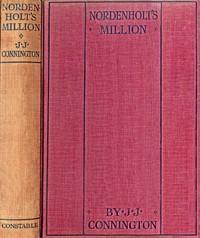
Before opening Nordenholt's Million — Background and Themes, the edition data offers a quick orientation: 101,710 words, 7 hr 23 min estimated reading time, and 25 detected text sections.
The text analysis averages about 18.9 words per sentence, while the detected sections provide another way to judge how the source is divided.
Project Gutenberg metadata also associates the work with “Science fiction,” connecting these edition facts with the source record’s subject description.
Explore this collection
These alternatives are selected using recorded categories and estimated reading time.
About 460 minutes
Machines Inventions Early Science Fiction
105,689 recorded words. 17 minutes difference from this book's estimate.
View Gutenberg source #59499About 416 minutes
Machines Inventions Early Science Fiction
95,531 recorded words. 27 minutes difference from this book's estimate.
View Gutenberg source #60455About 471 minutes
Machines Inventions Early Science Fiction
108,291 recorded words. 28 minutes difference from this book's estimate.
View Gutenberg source #62758Search stored excerpts and compare books → Choose by your preferences →
Choices use stored catalog measurements. Estimates vary with reading speed. A shared category is a catalog label, not a claim that two books have the same argument or literary quality.
Search reads excerpt text stored with this catalog and links to its associated Gutenberg record. The connection is stored in the site database; this tool does not recheck that every excerpt is word-for-word identical to that external record. Excerpt search does not cover every chapter and does not verify historical publication dates.
Catalog snapshot checked: 2026-09-26. Coverage: 98 public books, 98 available source excerpts.
Calculated from edition completeness, EPUB availability, text structure and catalogue metadata. Not a user rating.
Total of 100 points, scaled to a 2.5-5.0 range. Editions with an empty description or a missing EPUB file are not scored.
Public-domain source text
The source text is kept in the dedicated reader, separate from this catalogue record and its commentary.
The narrator, a mass-production motor-car manufacturer, introduces himself as a man whose “strong point” was organisation. This self-assessment is not idle; the entire novel is structured around his capacity to plan and execute under pressure. The story unfolds in three distinct movements: the genesis of a survival plan in a country house, the construction of a fortified agricultural colony in the Clyde Valley, and a harrowing journey into a lawless London. Each phase tests a different kind of order—financial, industrial, social—against the backdrop of a biological catastrophe that has destroyed the world's ability to fix nitrogen naturally.
The opening chapters establish a world before collapse through the narrator's professional identity. He is a man of systems: he had introduced “a new system of control” into his factories, and his mind works in terms of mass-production and efficiency. The first crisis arrives not as a bang but as a slow-motion agricultural disaster—a bacterial blight that attacks nitrogen-fixing plants. The narrative method is retrospective, with the narrator looking back from a later vantage point, which allows him to foreshadow without melodrama. The early scenes in Nordenholt's country house are dominated by talk of finance, chemistry, and logistics, not heroics. The tone is clinical, almost like a business report, which makes the later chaos more jarring.
Once the decision is made to retreat to the Clyde Valley, the novel shifts into a mode of construction. The narrator details the conversion of a valley into a self-sufficient enclave: the building of dams, the planting of crops, the rationing of supplies. The recurring image is that of a “Fata Morgana”—a dream-city on the clouds—which the characters hope to make real. The narrator admits he can lay “the foundations securely” while his female colleague Elsa would build “those fragile upper courses.” This division of labour reflects a broader tension between practical survival and the desire for a humane society. The section is dense with technical detail about nitrogen fixation, crop rotation, and industrial processes, grounding the speculative premise in concrete problem-solving.
Chapter XII, “Nuit Blanche,” marks a sharp change in register. The narrator flies south to London on a reconnaissance mission, and the prose becomes taut and sensory. He sees from the air “a great pall of cloud” lit by a red glow “like the sky above a blast-furnace.” On the ground, a guide smears his face with burnt cork to make him look underfed and warns him to shoot first and ask questions later. The city is a place of hunger, violence, and silence. The contrast with the ordered Clyde Valley is deliberate: the same biological disaster has produced two different worlds. The narrator's professional composure is tested here; he must rely on his guide's local knowledge and his own nerve. The episode is self-contained, almost a novella within the novel, and it gives the reader a visceral sense of what the enclave is trying to escape.
Throughout the excerpts, a recurring structural device is the moment of choice. Nordenholt imposes conditions on the narrator: he must take on Elsa as a colleague, and he must not tell her about the state of London. The narrator accepts without fully understanding the emotional cost. Later, in the London section, he must decide when to shoot, when to trust, when to retreat. The novel's title—Nordenholt's Million—refers to a financial stake, but the real currency is decisions. The narrator's voice remains level even when describing violence, which creates a strange emotional distance. This is not a story about heroes or villains; it is about the mechanics of survival and the slow erosion of ordinary life. The reader is left to infer the psychological toll from what is left unsaid.
The novel rewards readers who pay attention to its structural shifts: from the measured pace of planning to the compressed urgency of the London episode. The narrator's professional tone can be deceptive; it is worth noting what he does not describe—the faces of the starving, the sound of gunfire, the smell of the city. The gaps are as telling as the details. For those interested in early twentieth-century disaster fiction, this work offers a distinctive blend of industrial realism and speculative biology, anchored by a protagonist who is more organiser than adventurer.
Reading about the boardroom calculations in Nordenholt's Million, I remembered my grandfather’s methodical ledger during the dust bowl years—how order felt like a shelter. That same ache for connection amidst ruin surfaced later in Highland Mary: The Romance of a Poet A Novel — Background and Themes, where a fragile human bond becomes the quiet counterweight to a world losing its green. Both left me holding my breath.
Your answers remain private and are stored only in this browser.