About 174 minutes
Disappeared From Her Home: A Novel — A Closer Reading
Fantasy Juvenile Worlds
39,846 recorded words. 10 minutes difference from this book's estimate.
View Gutenberg source #65012
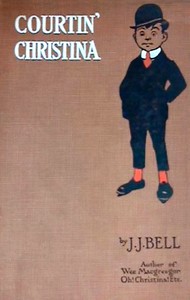
For Courtin' Christina — Key Ideas to Explore, the stored edition analysis reports 37,498 words, 2 hr 44 min estimated reading time, and 17 detected text sections.
The text analysis averages about 13.8 words per sentence, while the detected sections provide another way to judge how the source is divided.
Project Gutenberg metadata also associates the work with “Courtship -- Fiction,” connecting these edition facts with the source record’s subject description.
Explore this collection
These alternatives are selected using recorded categories and estimated reading time.
About 174 minutes
Fantasy Juvenile Worlds
39,846 recorded words. 10 minutes difference from this book's estimate.
View Gutenberg source #65012About 185 minutes
Fantasy Juvenile Worlds
42,457 recorded words. 21 minutes difference from this book's estimate.
View Gutenberg source #58897About 204 minutes
Fantasy Juvenile Worlds
46,823 recorded words. 40 minutes difference from this book's estimate.
View Gutenberg source #64852Search stored excerpts and compare books → Choose by your preferences →
Choices use stored catalog measurements. Estimates vary with reading speed. A shared category is a catalog label, not a claim that two books have the same argument or literary quality.
Search reads excerpt text stored with this catalog and links to its associated Gutenberg record. The connection is stored in the site database; this tool does not recheck that every excerpt is word-for-word identical to that external record. Excerpt search does not cover every chapter and does not verify historical publication dates.
Catalog snapshot checked: 2026-09-26. Coverage: 98 public books, 98 available source excerpts.
Calculated from edition completeness, EPUB availability, text structure and catalogue metadata. Not a user rating.
Total of 100 points, scaled to a 2.5-5.0 range. Editions with an empty description or a missing EPUB file are not scored.
Public-domain source text
The source text is kept in the dedicated reader, separate from this catalogue record and its commentary.
The novel opens not with the title character but with the Robinson family gathered for tea, a scene thick with dialect and domestic tension. Mrs. Robinson urges everyone to eat without waiting for Macgregor, while Gran'paw Purdie, newly arrived from the coast, checks his watch. The narrative then jumps eight years, summarizing changes in the household: Jimsie is now a schoolboy, Jeannie a devoted sister, and John balding but cheerful. This structural leap signals that the story prioritizes character evolution over linear chronology.
The first chapter establishes the Robinsons through a single, vivid meal. Dialogue is thick with Scots vernacular—'Come awa’,’ ‘Whisht,’ ‘fayther’—and the family dynamics are sketched with economy: John defers to his wife, Jimsie is hungry, and grace is said before eating. The narrator then abruptly announces an eight-year gap, offering capsule updates on each member. This technique gives readers a foundation in the family’s baseline before the story moves forward. Notably, Macgregor is absent from the table, a detail that may foreshadow his role in Christina’s life.
In a later excerpt, Christina debates the nature of business with Miss Tod, her elderly employer. When Miss Tod defines business as ‘jist buyin’ and sellin’,’ Christina counters that it ‘chiefly consists in folk coddin’ yin anither.’ She distinguishes ‘coddin’’ from deception, likening it to the difference between war and murder. Her examples—advertising, talk, smiles—are drawn from everyday commerce. The exchange reveals Christina as a sharp observer who questions social conventions, yet she softens her critique by admitting even her honest uncle once ‘codded’ her into buying unsellable goods.
Bell uses dialect not merely for local color but to mark social and emotional registers. Christina shifts between broad Scots and ‘correct speech’—for instance, dropping the vernacular when she says ‘I am not offended.’ Miss Tod grows nervous when Christina speaks ‘in such correct speech,’ highlighting class and generational tensions. The narrator’s own voice is lightly ironic, as when describing John’s bald spot as ‘to his wife’s dismay.’ These linguistic choices give the novel a layered texture, where how something is said matters as much as what is said.
Glasgow in the early 1900s is evoked through small, concrete details: a ‘three-roomed modern flat,’ a ‘fancy ink-pot’ that has sat unsold for ten years, stewed finnan haddie for tea. The Robinson home is a space of order and pride for Lizzie, while Miss Tod’s shop suggests a slower pace of commerce. These settings ground the characters’ concerns—courtship, work, family—in a specific material world. Readers attentive to period texture will find clues about housing, diet, and the rhythms of urban Scottish life.
As you read, note how the novel balances its romantic plot with social observation. Christina’s ideas about ‘coddin’’ may echo in later interactions, and the Robinson family dynamics introduced in the first chapter likely resurface. The excerpts give a strong sense of voice and setting, but the full arc of the courtship remains to be discovered. Pay attention to how Bell uses dialect and direct speech to reveal character, and whether Christina’s philosophy holds up in matters of the heart.
Christina’s teasing questions about honesty made me think of that old garret, where the dust holds every secret a family didn’t say aloud. There’s a quiet ache in both—how we play at truth and then live with what we hide. Up in the garret — Background and Themes stayed with me like a half-remembered voice.
Your answers remain private and are stored only in this browser.