About 257 minutes
Mr. Fortune's Practice — Text and Context
Fantasy Juvenile Worlds
59,038 recorded words. 0 minutes difference from this book's estimate.
View Gutenberg source #60096
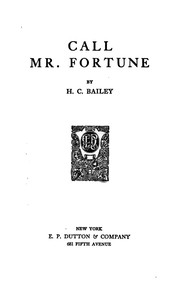
This digital edition of Call Mr. Fortune — Text and Context is described by source-level measurements including 59,089 words, 4 hr 17 min estimated reading time, and 6 detected text sections.
The text analysis averages about 9.4 words per sentence, while the detected sections provide another way to judge how the source is divided.
Project Gutenberg metadata also associates the work with “Detective and mystery stories,” connecting these edition facts with the source record’s subject description.
Explore this collection
These alternatives are selected using recorded categories and estimated reading time.
About 257 minutes
Fantasy Juvenile Worlds
59,038 recorded words. 0 minutes difference from this book's estimate.
View Gutenberg source #60096About 248 minutes
Fantasy Juvenile Worlds
57,025 recorded words. 9 minutes difference from this book's estimate.
View Gutenberg source #63072About 247 minutes
Fantasy Juvenile Worlds
56,757 recorded words. 10 minutes difference from this book's estimate.
View Gutenberg source #62820Search stored excerpts and compare books → Choose by your preferences →
Choices use stored catalog measurements. Estimates vary with reading speed. A shared category is a catalog label, not a claim that two books have the same argument or literary quality.
Search reads excerpt text stored with this catalog and links to its associated Gutenberg record. The connection is stored in the site database; this tool does not recheck that every excerpt is word-for-word identical to that external record. Excerpt search does not cover every chapter and does not verify historical publication dates.
Catalog snapshot checked: 2026-09-26. Coverage: 98 public books, 98 available source excerpts.
Calculated from edition completeness, EPUB availability, text structure and catalogue metadata. Not a user rating.
Total of 100 points, scaled to a 2.5-5.0 range. Editions with an empty description or a missing EPUB file are not scored.
Public-domain source text
The source text is kept in the dedicated reader, separate from this catalogue record and its commentary.
The first case, “The Archduke’s Tea,” introduces Reginald Fortune not through a crime but through a lecture from his father, who complains he does “only just enough.” The narrative voice is wry, self-contained: Fortune eats his third muffin while his parents depart, musing on his father’s “death-bed manner for a tummy-ache.” This opening establishes a detective who is both indolent and observant, a man who knows enough about everything to find his way about. The story quickly shifts from domestic comedy to a murder investigation, but the tone remains conversational, with Fortune’s offhand remarks often concealing sharp deductions.
Fortune’s investigations take him from the opulent homes of Westhampton to the gritty edges of canals and flats. In “The Archduke’s Tea,” he examines a car’s tire tracks on a narrow gravel road, noting that a car stopping there was unprecedented. The scene shifts to Herbert Charlecote’s elaborate flat, where Fortune opens casement windows to smell “oak-leaf geranium and verbenas,” remarking that the scents are “rather oily.” This attention to sensory detail—the feel of loose gravel, the smell of flowers—grounds the narrative in physical spaces. The movement between settings is not merely scenic; each location yields clues: a betting-book with a single letter “N,” a bank manager’s letter, a man-servant’s pallor. Fortune’s method is to let the environment speak, then act on its hints.
Cars appear repeatedly as instruments of conveyance and concealment. In the first case, a car is used to transport a body to a canal; later, Fortune’s own car “broke the law on the way back.” The canal itself is a recurring image—a place where bodies are dumped, discovered only when a barge “stirs them up.” The violence is often implied rather than shown: Herbert Charlecote is found dead, but the narrative focuses on the aftermath—the trampled grass, the torn gravel, the elaborate room. Fortune’s response is typically understated: “I don’t feel sentimental about dear Herbert’s doom.” This detachment, combined with his sudden leaps of inference (deducing that “N” stands for Newton from a single letter), creates a pattern of calm observation punctuated by decisive action.
Fortune’s speech is marked by colloquialisms and ironic asides: “Quaint old bird, the pater,” “Fretful game to spend your life waitin’ for a man to get ready.” He addresses colleagues with affectionate mockery (“Lomas, old thing?”) and punctuates his deductions with laughter. The narrative voice matches this tone, describing Fortune as “self-sufficient” and “more at his ease with the world than a man has a right to be at thirty-five.” The structure of each case follows a pattern: a crime is reported, Fortune visits the scene, examines physical evidence, and makes a sudden intuitive leap. But the leaps are grounded in specific details—a bank statement, a betting-book, a man’s pallor. The stories are not puzzles to be solved by logic alone; they rely on Fortune’s ability to read people and places simultaneously.
Superintendent Bell and Inspector Lomas serve as foils to Fortune’s brilliance. Bell is described as touching “the spot” on multiple occasions, pointing out crucial evidence that Fortune then builds upon. In the first case, Bell notes the betting-book’s single “N,” prompting Fortune to spring into action. Lomas, meanwhile, is often puzzled by Fortune’s methods: “I suppose you’re playing some hand of your own,” he frowns. This dynamic creates a rhythm of observation, suggestion, and deduction. Fortune does not work alone; he relies on the police for legwork and local knowledge. But his final insights often come from a detail they overlooked—a scent, a footprint, a casual remark. The interplay between the three characters drives the narrative forward, with Fortune’s quiet persistence contrasting with the more conventional police procedures.
These six cases reward readers who attend to small details: a geranium’s scent, a car’s tire tracks, a single letter in a betting-book. Fortune’s method is not to explain but to notice, and the stories unfold through his laconic observations. The collection offers a portrait of a detective who is both of his time—Edwardian in his comfort and class—and ahead of it in his forensic instincts. Read for the pleasure of watching a sharp mind work through the clutter of everyday life.
Some stories stay with you like a quiet evening, and Call Mr. Fortune had that unhurried persistence—its sharp observer moving through rooms and rivers with a gentleness that feels almost private. It reminded me of the soft notes in Abaft the Funnel — Reading Notes, where observation lingers without needing to arrive anywhere loudly. Both feel like half-remembered conversations, not conclusions.
Save your reaction, strongest insight, and memorable passage.