About 174 minutes
Disappeared From Her Home: A Novel — A Closer Reading
Fantasy Juvenile Worlds
39,846 recorded words. 11 minutes difference from this book's estimate.
View Gutenberg source #65012
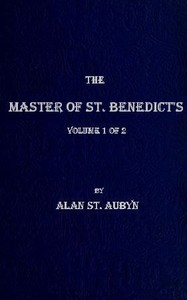
The source record for The master of St. Benedict's, Vol. 1 (of 2) — Key Ideas to Explore measures this digital text at 42,457 words, 3 hr 5 min estimated reading time, and 4 detected text sections.
The text analysis averages about 17.9 words per sentence, while the detected sections provide another way to judge how the source is divided.
Project Gutenberg metadata also associates the work with “School principals -- Fiction,” connecting these edition facts with the source record’s subject description.
Explore this collection
These alternatives are selected using recorded categories and estimated reading time.
About 174 minutes
Fantasy Juvenile Worlds
39,846 recorded words. 11 minutes difference from this book's estimate.
View Gutenberg source #65012About 204 minutes
Fantasy Juvenile Worlds
46,823 recorded words. 19 minutes difference from this book's estimate.
View Gutenberg source #64852About 164 minutes
Fantasy Juvenile Worlds
37,498 recorded words. 21 minutes difference from this book's estimate.
View Gutenberg source #63806Search stored excerpts and compare books → Choose by your preferences →
Choices use stored catalog measurements. Estimates vary with reading speed. A shared category is a catalog label, not a claim that two books have the same argument or literary quality.
Search reads excerpt text stored with this catalog and links to its associated Gutenberg record. The connection is stored in the site database; this tool does not recheck that every excerpt is word-for-word identical to that external record. Excerpt search does not cover every chapter and does not verify historical publication dates.
Catalog snapshot checked: 2026-09-26. Coverage: 98 public books, 98 available source excerpts.
Calculated from edition completeness, EPUB availability, text structure and catalogue metadata. Not a user rating.
Total of 100 points, scaled to a 2.5-5.0 range. Editions with an empty description or a missing EPUB file are not scored.
Public-domain source text
The source text is kept in the dedicated reader, separate from this catalogue record and its commentary.
The novel opens not with a scene but with a summary: the Master of St. Benedict's has "got as much out of life as most men." This retrospective framing immediately establishes a tone of measured reflection, as the narrator traces his rise from a Yorkshire ploughboy to a Cambridge college head. The first chapter, titled "Full of Days, Riches, and Honour," catalogues his achievements in a deliberate sequence—ambition, wealth, success, love—before revealing that love came late, at sixty. This opening invites readers to expect a life story told from its summit, but the excerpts suggest the narrative soon shifts to other characters and crises.
The opening chapter functions as a compressed biography. The Master's origins are sketched with specific details: a "bleak Yorkshire moor," a "kindly North Riding vicar," a grammar school scholarship, and a Cambridge arrival with "a very few loose coins" and a "broad North-country dialect." The narrator notes that he was the butt of practical jokes during his freshman year, yet he "stayed 'up' when the witty men had gone 'down.'" This phrasing—using the Cambridge terms 'up' and 'down'—grounds the story in university idiom. The retrospective tone, however, raises a question: if the Master's life is already complete, what conflict remains? The excerpts hint that the answer lies not in his past but in the present troubles of others.
A later excerpt introduces Lucy, a character not mentioned in the opening. She visits Addenbroke's Hospital, where a medical student leads her through a ward described as "a large, delightful chamber, well lighted and cheerful," with "a bank of tall palms and ferns." The nurse's room is tiny, partitioned off, with texts in Latin and Greek and one in English: "Inasmuch as ye do it unto the least of these My brethren, ye do it unto Me." Lucy notices the room's disorder—breakfast things still out, a bonnet thrown on the bed. The nurse, Miss Brannan, is "a little bit of a nurse, with pink cheeks and steady blue eyes." Their conversation reveals that a male patient (likely a student from St. Benedict's) has a wound from a fit of delirium tremens, not from an accident. This scene shifts the novel's focus from the Master's serene retrospect to a medical and moral crisis.
The excerpts juxtapose two settings: the college, with its traditions and hierarchies, and the hospital, with its clinical routines and human fragility. The Master's story is one of steady ascent; the hospital scene is one of sudden collapse. Lucy's perspective is that of an outsider—she is "moved out of all sense and reason" by the news, while the nurse remains calm, "so used to such things." The narrator notes that Lucy "would have been no good at Addenbroke's," a dry comment that underscores her emotional vulnerability. The hospital ward, with its palms and ferns, is described as "an oasis of verdure for tired eyes to feast upon," a detail that suggests a deliberate contrast to the stone and oak of Cambridge. This structural opposition—between the Master's accumulated honours and a young man's self-inflicted danger—creates a tension that the excerpts do not resolve.
The excerpts leave several questions unanswered. How does Lucy connect to the Master? Is the injured student a relative or a college member? The chapter titles in the contents list—"Dick's Little Daughter," "Only a Fresher," "Pamela Gwatkin," "A Woman's Parliament"—suggest multiple subplots and a cast that extends beyond the college. The title "The Master of St. Benedict's" might imply a single protagonist, but the excerpts show the narrative spreading to other characters. Readers should expect a multi-threaded story, with the Master perhaps serving as a fixed point around which younger lives revolve. The hospital scene, with its precise details of room and conversation, indicates that the author values concrete observation over moralizing, even when the subject is a taboo topic like delirium tremens.
As you read, pay attention to how the narrator shifts between the Master's measured past tense and the immediate present of scenes like Lucy's hospital visit. The novel may be less about the Master himself than about the community he oversees—students, nurses, daughters, and fellows. The excerpts suggest a work that balances institutional dignity with personal crisis, and that uses Cambridge settings not just as backdrop but as a force that shapes characters' choices.
There’s a moment in The Master of St. Benedict’s where the quiet of college halls feels heavier than any storm, and I found myself thinking of another book’s lonely campfire—how solitude shapes a man differently when the walls are stone versus open sky. That same hush lingers in Smoke of the .45 — Story, Setting & Ideas, almost like an echo I hadn’t expected to hear.
A brief reflection can help important ideas stay with you longer.