About 257 minutes
Call Mr. Fortune — Text and Context
Fantasy Juvenile Worlds
59,089 recorded words. 0 minutes difference from this book's estimate.
View Gutenberg source #59653
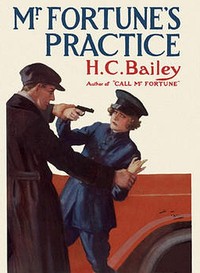
This digital edition of Mr. Fortune's Practice — Text and Context is described by source-level measurements including 59,038 words, 4 hr 17 min estimated reading time, and 6 detected text sections.
The text analysis averages about 9.4 words per sentence, while the detected sections provide another way to judge how the source is divided.
Project Gutenberg metadata also associates the work with “Detective and mystery stories,” connecting these edition facts with the source record’s subject description.
Explore this collection
These alternatives are selected using recorded categories and estimated reading time.
About 257 minutes
Fantasy Juvenile Worlds
59,089 recorded words. 0 minutes difference from this book's estimate.
View Gutenberg source #59653About 248 minutes
Fantasy Juvenile Worlds
57,025 recorded words. 9 minutes difference from this book's estimate.
View Gutenberg source #63072About 247 minutes
Fantasy Juvenile Worlds
56,757 recorded words. 10 minutes difference from this book's estimate.
View Gutenberg source #62820Search stored excerpts and compare books → Choose by your preferences →
Choices use stored catalog measurements. Estimates vary with reading speed. A shared category is a catalog label, not a claim that two books have the same argument or literary quality.
Search reads excerpt text stored with this catalog and links to its associated Gutenberg record. The connection is stored in the site database; this tool does not recheck that every excerpt is word-for-word identical to that external record. Excerpt search does not cover every chapter and does not verify historical publication dates.
Catalog snapshot checked: 2026-09-26. Coverage: 98 public books, 98 available source excerpts.
Calculated from edition completeness, EPUB availability, text structure and catalogue metadata. Not a user rating.
Total of 100 points, scaled to a 2.5-5.0 range. Editions with an empty description or a missing EPUB file are not scored.
Public-domain source text
The source text is kept in the dedicated reader, separate from this catalogue record and its commentary.
H. C. Bailey's Mr. Fortune's Practice (1923) opens with a distinctive narrative voice that sets the tone for the six cases collected here. The first story, “The Ascot Tragedy,” begins not with a crime but with a conversation: Reggie Fortune, plump and pinkly healthy, complains to his friend Lomas that the Royal Enclosure makes him feel “anatomical, ethnological, anthropological.” This self-deprecating humour—Fortune describing himself as “the three fellows in the Bible who sang in the furnace”—establishes a detective who is both scientifically precise and personally unsettled by the human messiness of crime. Bailey’s prose is brisk and conversational, with sharp dialogue that reveals character through idiom and rhythm.
Reggie Fortune is no cold-blooded reasoner. In the opening pages, he tells Lomas, “I don’t like men dying, that’s all. Professional prejudice. I’m a doctor, you see.” This admission—that his medical training makes him afraid of murder—runs counter to the typical detective’s relish for puzzle-solving. Bailey reinforces this through Fortune’s physical reactions: he groans, he is “pensive,” he looks with a “baleful eye.” When Lomas teases him for being “the knight of the rueful countenance,” Fortune corrects him with pedantic irritation. The tension between Fortune’s professional role as a scientific adviser and his personal aversion to death is a recurring pattern. He does not seek out crime; he is drawn into it reluctantly, and his deductions are laced with moral discomfort.
Bailey uses setting and dialogue to sketch social hierarchies. The Ascot scene is described with ironic precision: “comely girls and women who had been comely,” men of “blameless, inconspicuous uniformity.” Fortune’s eye picks out a darker-complexioned man whose feet betray something amiss—a detail Lomas misses. Later, the heir George Coppett speaks in a clipped, upper-class slang: “He’s simply potty about his curios,” “Search me,” “He always was a close old thing.” His flat is furnished with whisky and a telephone; his manner is brusque and evasive. Bailey contrasts this with Fortune’s more measured, analytical speech. The telephone call to “Millfield, double three something” introduces a suburban note that jars with Coppett’s sporting milieu, hinting at hidden connections. These linguistic and spatial details build a world where what is said is less important than how and where it is said.
The excerpt from “The Ascot Tragedy” establishes a pattern of characters who deflect, lie, or disappear. Lord Tetherdown has vanished; his heir claims ignorance but immediately telephones a suburban number. Fortune’s “workin’ hypothesis” is that “there’s dirty work doin’ when a magic stone gets stolen and the man who wants the magic stone vanishes on the same day.” The chain of inference—linking a stolen stone, a missing lord, a female accomplice, and a suspicious heir—is built on circumstantial connections rather than hard evidence. Lomas objects: “There’s not an ounce of evidence.” Fortune’s reply—“You like your evidence after the murder”—exposes a central tension in the collection: the gap between forensic proof and the intuitive dread that drives Fortune forward. The reader is left to weigh whether his unease is justified or merely professional paranoia.
Readers approaching Mr. Fortune's Practice should attend to the interplay between Fortune's scientific method and his emotional responses. Bailey does not provide tidy resolutions; instead, he foregrounds the process of suspicion and the discomfort of incomplete knowledge. The stories reward attention to dialogue, setting, and the small details that Fortune himself notices—the wrong sort of feet, the wrong sort of telephone call. Treat each case as a study in how evidence accumulates, rather than a puzzle with a single solution.
I keep thinking about how Mr. Fortune's Practice lets you sit with the uncomfortable gap between solving a case and actually feeling settled by it. That same quiet ache lives in The heir: A love story — Background and Themes, where certainty about people slips away just when you need it most. Both left me wondering more than they answered, and I'm still carrying that.
Save your reaction, strongest insight, and memorable passage.