About 27 minutes
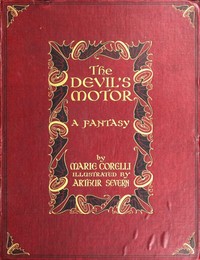
The Devil's Motor: A Fantasy — Context and Discussion
Fantasy Juvenile Worlds
6,118 recorded words. 7 minutes difference from this book's estimate.
View Gutenberg source #61716
This digital edition of Up in the garret — Background and Themes is described by source-level measurements including 7,800 words, 34 min estimated reading time, and 9 detected text sections.
The text analysis averages about 19.0 words per sentence, while the detected sections provide another way to judge how the source is divided.
Project Gutenberg metadata also associates the work with “Siblings -- Juvenile fiction,” connecting these edition facts with the source record’s subject description.
Explore this collection
These alternatives are selected using recorded categories and estimated reading time.
About 27 minutes
Fantasy Juvenile Worlds
6,118 recorded words. 7 minutes difference from this book's estimate.
View Gutenberg source #61716About 164 minutes
Fantasy Juvenile Worlds
37,498 recorded words. 130 minutes difference from this book's estimate.
View Gutenberg source #63806About 174 minutes
Fantasy Juvenile Worlds
39,846 recorded words. 140 minutes difference from this book's estimate.
View Gutenberg source #65012Search stored excerpts and compare books → Choose by your preferences →
Choices use stored catalog measurements. Estimates vary with reading speed. A shared category is a catalog label, not a claim that two books have the same argument or literary quality.
Search reads excerpt text stored with this catalog and links to its associated Gutenberg record. The connection is stored in the site database; this tool does not recheck that every excerpt is word-for-word identical to that external record. Excerpt search does not cover every chapter and does not verify historical publication dates.
Catalog snapshot checked: 2026-09-26. Coverage: 98 public books, 98 available source excerpts.
Calculated from edition completeness, EPUB availability, text structure and catalogue metadata. Not a user rating.
Total of 100 points, scaled to a 2.5-5.0 range. Editions with an empty description or a missing EPUB file are not scored.
Public-domain source text
The source text is kept in the dedicated reader, separate from this catalogue record and its commentary.
Robin Ranger opens Up in the Garret by directly challenging the reader: 'You may laugh when I say that I want to talk to you about the GARRET of the house.' This conversational gambit, addressed to a hypothetical 'Master Flurry,' establishes a narrator who anticipates skepticism and uses it to draw the child reader in. The garret is described with a precise inventory—'old bedsteads and chairs waiting to be mended; trunks, valises, and carpet-bags ready for traveling; rolls of spare carpet, matting, and oil cloth'—that reflects Mrs. Bondy's motto, 'A place for everything, and everything in its place.' Ranger's diction here is concrete and domestic, grounding the story in material details rather than abstract moralizing.
Ranger's narrator is anything but invisible. He interrupts the description of the garret to banter with the reader: 'But stop a moment, Master Flurry, (if that is your name.) Isn't there a garret to your house? And don't you go there sometimes to play, or to find something that has been put in the rag bag?' This direct address creates an intimacy that is both playful and instructional. The narrator assumes a child audience that might be reluctant, and he uses that assumption to build rapport. Later, when the children ask for another story, the narrator lets Mr. Bondy deflect: 'Not this time, I guess, my child.' The voice is consistently that of a friendly adult who knows how to keep a story moving without losing the moral thread.
The garret is not merely a setting; it is described with the care one might give a character. Ranger devotes the first chapter to 'How the Garret Looked,' listing its contents in a way that suggests both order and potential: 'hats in bandboxes, and boots without any boxes; rag bags, and bags without any rags.' The repetition of 'bags' and the playful inversion ('bags without any rags') hint at a world where things are slightly out of kilter. The garret has 'four small windows' and 'a chimney between each pair,' details that later prove crucial when a swallow falls down the unused chimney. The space is both a storage room and a stage for the children's adventures, and Ranger ensures the reader can picture it exactly.
In Chapter V, Mr. Bondy tells a story about a swallow that falls down a chimney and is rescued by a girl named Jane. This embedded tale is told in a simpler, more direct style than the frame narrative: 'Its nest was near the top of the chimney, and somehow or other it had fallen down during the night upon the straw which stopped up the chimney.' The swallow's plight is described without sentimentality, and Jane's decision to release it rather than cage it is presented as a natural moral choice. Ranger uses the episode to model compassion without lecturing. The children's reaction—Maggie calls it 'a pretty story'—shows that the lesson has landed, but the narrator does not belabor the point.
Ranger gives each of the Bondy children a distinct line of dialogue when Mr. Bondy asks how they would like to live in a garret. Abby says it would be 'too cold in winter,' Alice 'too hot in summer,' Mark 'too dark all the time,' Maggie fears 'rats and mice,' and Jimmie boasts he would 'shoot them with my gun.' These quick, individual responses reveal character through voice: Jimmie is bold but untested, Maggie is cautious, and the older girls are practical. Mr. Bondy then pivots to a sobering description of poor families living in leaky garrets, and the children's mood shifts. Alice's wish to help 'if there were any such living near' shows that the lesson has taken root, but Ranger does not let the story become heavy; the rain stops, sunshine returns, and the family goes down to tea.
Ranger's Up in the Garret rewards attention to its small structural choices: the direct-address narrator, the inventory of attic objects, the embedded swallow story, and the children's distinct voices. These elements work together to create a Sunday-school tale that is more than a moral lesson—it is a careful study of how a domestic space can become a site of both play and instruction. Readers interested in nineteenth-century children's literature will find here a compact example of the didactic tradition at its most engaging.
That garret full of old things and a rescued swallow made me think of my childhood attic, dust motes in the light, and how a single object could spin into a whole story. Jesse James' Bold Stroke; Or, The Double Bank Robbery — Reading Notes once gave me that same quiet ache — not for the adventure itself, but for the solemn way a child turns a real fear into a game of pretend. I felt that again here, in the way those children made a castle of a cramped room.
Answer a few questions and save a private reflection on this device.