About 204 minutes
George Helm — Inside the Classic
Fantasy Juvenile Worlds
46,823 recorded words. 10 minutes difference from this book's estimate.
View Gutenberg source #64852
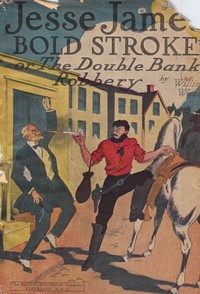
The source record for Jesse James' Bold Stroke; Or, The Double Bank Robbery — Reading Notes measures this digital text at 49,095 words, 3 hr 34 min estimated reading time, and 6 detected text sections.
The text analysis averages about 14.6 words per sentence, while the detected sections provide another way to judge how the source is divided.
Project Gutenberg metadata also associates the work with “Western stories,” connecting these edition facts with the source record’s subject description.
Explore this collection
These alternatives are selected using recorded categories and estimated reading time.
About 204 minutes
Fantasy Juvenile Worlds
46,823 recorded words. 10 minutes difference from this book's estimate.
View Gutenberg source #64852About 225 minutes
Fantasy Juvenile Worlds
51,554 recorded words. 11 minutes difference from this book's estimate.
View Gutenberg source #60368About 185 minutes
Fantasy Juvenile Worlds
42,457 recorded words. 29 minutes difference from this book's estimate.
View Gutenberg source #58897Search stored excerpts and compare books → Choose by your preferences →
Choices use stored catalog measurements. Estimates vary with reading speed. A shared category is a catalog label, not a claim that two books have the same argument or literary quality.
Search reads excerpt text stored with this catalog and links to its associated Gutenberg record. The connection is stored in the site database; this tool does not recheck that every excerpt is word-for-word identical to that external record. Excerpt search does not cover every chapter and does not verify historical publication dates.
Catalog snapshot checked: 2026-09-26. Coverage: 98 public books, 98 available source excerpts.
Calculated from edition completeness, EPUB availability, text structure and catalogue metadata. Not a user rating.
Total of 100 points, scaled to a 2.5-5.0 range. Editions with an empty description or a missing EPUB file are not scored.
Public-domain source text
The source text is kept in the dedicated reader, separate from this catalogue record and its commentary.
From the opening cry of “Look! Look!” in a darkening Colorado canyon, William Ward’s Jesse James’ Bold Stroke establishes a rhythm of sudden danger and narrow escape. The narrative moves through a series of tightly compressed episodes—capture by Indians, a dynamite blast, a double bank robbery—each hinging on a moment of surprise. The prose favors short, punchy sentences and exclamations that mimic the breathlessness of pursuit. This note traces three structural and imagistic patterns visible in the excerpts: the repeated use of feigned death as a plot device, the shifting role of the landscape from trap to weapon, and the way movement between scenes is signaled by abrupt changes in setting rather than transitional exposition.
Twice in the provided excerpts, Jesse James escapes by pretending to be dead. In the first instance, after a volley of Winchesters, he “stiffened out and lay motionless in well-feigned emulation of death.” The soldiers, convinced he is gone, approach to lift him onto a litter—only for Jesse to stab two troopers with bowies and leap onto a pony. The second instance occurs earlier in the text (not fully excerpted) when he is captured by Indians and later rescued. This pattern suggests that the narrative treats death as a reversible state, a temporary mask that the hero can put on and discard. The ruse depends on the observers’ willingness to accept stillness as finality, a gamble that pays off repeatedly. Ward underscores the theatricality of these moments by describing Jesse’s movements as “lightning-like” and his spring as “impelled by some giant spring,” emphasizing sudden animation after stillness.
The setting in the opening chapter is a canyon with “solid walls of rock” and a dry torrent bed, described as “sinister and awesome in the half light.” This enclosed space functions as a natural trap, hemming the riders in. Yet later, Jesse uses the terrain to his advantage: he drops to the ground when fired upon, letting bullets pass “harmlessly over his head,” and a pony’s movement “between the main arm of the troop and the prostrate outlaw” hides his actions. The landscape is not merely backdrop but an active participant—the “virgin rocks” are stained with blood, and the “moonbeams” alternately reveal and conceal. Ward also introduces a “Witch’s Cave” and a moment “when the earth fell apart,” suggesting that the physical world can be both shelter and weapon. The dynamite blast that destroys an Indian village is the most extreme example of turning the environment into an explosive tool.
The chapter titles in the table of contents—such as “Tied to the Stake,” “The Flight from the Cliff,” “In a Living Tomb”—promise a rapid succession of crises. Within the excerpts, scene changes are signaled by a single line break or a new paragraph rather than extended description. For instance, after Jesse’s escape on the pony, the narrative jumps to a later confrontation without explaining how he reached that point. This technique keeps the pace relentless; the reader is dropped into each new predicament with little orientation. The effect is that of a series of vignettes rather than a continuous journey. Ward relies on the reader’s familiarity with the Jesse James legend to fill in gaps, assuming that the outlaw’s resourcefulness is a given. The result is a story that moves from one high-stakes tableau to the next, each built around a single, vivid action—a stab, a leap, a yell.
Although the excerpts are limited, the catalog summary mentions that Jesse is “rescued by an Indian maiden” after being captured by Indians. This figure, named Dew Drop in the chapter list, appears to function as a helper who enables the hero’s escape. Her presence introduces a cross-cultural element that is typical of the Western genre but is handled here with minimal development. The Indians are initially presented as a collective threat—their fires are “like the luminous eyes of some wild monster”—and later as a force to be outwitted or destroyed. The maiden’s rescue, however, complicates this binary: she acts against her own people to aid Jesse. The narrative does not explore her motives; she is a plot device rather than a character. This treatment reflects the era’s conventions, where indigenous figures often serve as obstacles or exotic aids without interiority. The dynamite blast that destroys the village underscores the violent resolution of this encounter.
Readers approaching Jesse James’ Bold Stroke should expect a breakneck sequence of captures, escapes, and reversals rather than a sustained plot. The novel’s structure rewards attention to recurring motifs—especially feigned death and the manipulation of terrain—that Ward uses to generate suspense. Because the excerpts are incomplete, the full arc of the double bank robbery and the fate of the Indian maiden remain unclear, but the patterns visible here suggest a work that prioritizes action over character development. For those interested in early twentieth-century dime novels, this title offers a concentrated example of the genre’s formulaic yet energetic storytelling.
There’s something comforting about how Ward lets his characters slip into the brush, pausing just long enough to catch their breath before the next chase. I remember feeling that same quiet pause with George Helm — Inside the Classic, where the landscape holds its own secrets. It’s a slower, kinder kind of reading, the way old friends retell a story. George Helm — Inside the Classic stays with you like that.
Your answers remain private and are stored only in this browser.