
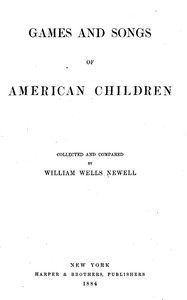
Games and songs of American children by William Wells Newell
Okay, let's clear something up first: this isn't a storybook with a beginning, middle, and end. It's a field guide to a vanished world. Published in 1883, William Wells Newell's book is exactly what the title promises: a huge collection of the games, rhymes, and songs American children played in the 19th century. He didn't make these up; he collected them from kids and communities all over the country, writing down the exact words, rules, and melodies.
The Story
There's no plot, but there is a journey. The book is organized by game type: singing games, counting-out rhymes, ball games, and more. You'll find the familiar ancestors of games we know, like 'London Bridge,' alongside utterly strange and wonderful ones that have completely disappeared. Each entry is a little snapshot. Newell often notes where he heard it and sometimes traces a rhyme's history back centuries to Europe, showing how it changed on American soil. The 'story' is the quiet, persistent one of how children keep culture alive, adapting old traditions into their play, often without any adults noticing.
Why You Should Read It
I picked this up out of curiosity and couldn't put it down. The power isn't in analysis; it's in the raw material. Reading the chants for games like 'Duck, Duck, Goose' (which they called 'Duck, Duck, Drakes') or the bizarre lyrics of forgotten ball-bouncing songs is genuinely captivating. It creates this weird, beautiful connection across time. You realize the kid skipping rope in 1880s New York was living in a completely different world, yet part of her mind was occupied with the same silly, rhythmic nonsense that occupies kids today. It reframes play as something deep and essential, not just a way to pass the time. It’s also often funny and charmingly bizarre.
Final Verdict
This book is a treasure, but it's for a specific reader. It's perfect for history lovers, folklore enthusiasts, teachers, or parents who want a deeper look at childhood's past. It's also great for writers looking for authentic period details. If you need a driving narrative, you might find it slow. But if you're the kind of person who loves peering into old diaries or wandering through museums imagining daily life, you'll be enthralled. Think of it less as a book to read cover-to-cover, and more as a fascinating archive to dip into. You'll never hear a playground chant the same way again.
This is a copyright-free edition. Preserving history for future generations.
Joseph Jones
11 months agoI found the author's tone to be very professional yet accessible, the bibliography and references suggest a high level of research and authority. It’s hard to find this much value in a single source these days.
David Davis
10 months agoI've gone through the entire material twice now, and the nuanced approach to the central theme was better than I expected. Thanks for making such a high-quality version available.
William Jones
10 months agoThe clarity of the introduction set high expectations, and the transition between theoretical knowledge and practical application is seamless. This exceeded my expectations in almost every way.
Charles Gonzalez
11 months agoA must-have for graduate-level students in this discipline.




Kimberly Garcia
2 months agoThought-provoking and well-organized content.