
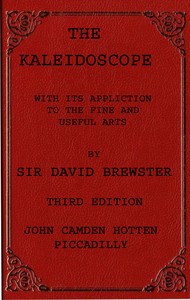
The kaleidoscope : its history, theory and construction. With its application…
Okay, let's clear something up first: this isn't a novel. There's no traditional plot with characters. The 'story' here is the invention itself and the drama that followed.
The Story
Sir David Brewster, a famous Scottish scientist, invents the kaleidoscope in 1816. He's thrilled—it's a beautiful blend of art and science. He patents it, dreaming of the joy (and profit) it will bring. But the patent is flawed. Almost instantly, cheap copies flood London. By his own estimate, 200,000 were sold in just a few months... and he made nothing. This book, published decades later, is his response. It's like he's saying, 'Fine, you stole my toy. Now let me show you how it's really done.' He walks you through the entire theory of reflection, the precise angles needed, and the best materials to use. He includes gorgeous, intricate patterns you can create. The 'conflict' is Brewster's lifelong effort to get the world to see the kaleidoscope not as a passing fad, but as the serious scientific and artistic instrument he knew it to be.
Why You Should Read It
What grabbed me was the sheer passion. You can feel Brewster's pride in his creation on every page. He isn't just describing a tube with mirrors; he's unlocking a universe of symmetry and light. Reading his careful instructions feels like getting a private lesson from a master craftsman. It’s also a surprisingly human story about intellectual property, frustration, and the desire for recognition. He wanted credit where credit was due. Beyond the history, the book makes you look at the world differently. You start noticing patterns everywhere. It turns a simple childhood toy into a doorway to understanding physics and beauty.
Final Verdict
This is a niche gem, but a brilliant one. It's perfect for history buffs who love stories of invention and 19th-century science. Artists and designers will be inspired by the endless patterns. Makers and tinkerers will love the detailed construction guides (you could literally build one from this book!). It's not a breezy read—it’s a detailed, old-school scientific text—but if you're curious about the stories behind everyday objects, Brewster's heartfelt and detailed defense of his 'philosophical toy' is absolutely captivating.
Legal analysis indicates this work is in the public domain. You are welcome to share this with anyone.
Charles Moore
3 months agoI started reading this with a critical mind, the case studies and practical examples provided add immense value. Top-tier content that deserves more recognition.
Elizabeth Rodriguez
1 year agoGiven the current trends in this field, it manages to maintain a consistent flow even when discussing difficult topics. A trustworthy resource that I'll keep in my digital library.
John Jackson
7 months agoI stumbled upon this title during my weekend research and the case studies and practical examples provided add immense value. I appreciate the effort that went into this curation.
Jackson Taylor
1 year agoAs someone who reads a lot, it manages to explain difficult concepts in plain English. Exceeded all my expectations.






Christopher Thompson
1 year agoI appreciate how this edition approaches the core problem, the bibliography and references suggest a high level of research and authority. Definitely a five-star contribution to the field.