
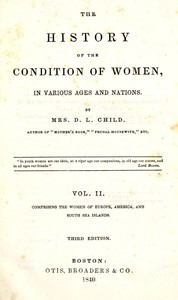
The history of the condition of women, in various ages and nations (vol. 2 of…
Lydia Maria Child, a powerhouse writer and abolitionist in 19th-century America, set out on an ambitious mission: to document the lives of women across the globe and throughout recorded history. This book is the second part of that huge project. Think of it less as a straight narrative and more as a guided tour. Child acts as your expert guide, stopping in different regions and time periods—from ancient civilizations to her own era—and showing you how women lived there.
The Story
There isn't a single plot, but there is a clear quest. Child is gathering evidence. She looks at laws about marriage and property, descriptions of daily work, religious teachings, and social customs. She compares the status of women in, say, ancient Greece with their status in the Middle East or in tribal societies. The 'story' is the pattern that emerges from all these pieces. It's about how power, economics, and religion combined to create the world women had to navigate. She shows the vast range of experiences, from relative freedom in some cultures to severe restriction in others, always asking 'why?'
Why You Should Read It
You should read this because it makes history feel immediate. Child isn't a detached scholar; her voice is present. You can sense her indignation when describing unfair laws and her admiration for cultures that granted women more autonomy. It reframes history. Battles and kings fade into the background, and the domestic sphere—the kitchen, the market, the marriage contract—comes into sharp focus as a place where history truly happened. It connects dots in a way that feels surprisingly modern, helping you understand the long roots of contemporary conversations about gender and equality.
Final Verdict
This is perfect for anyone who loves social history or is curious about the origins of our modern world. It's for the reader who enjoys books like Sapiens but wants a focused lens on one half of humanity. Be prepared for its 19th-century style, but if you push through, you'll find a radical and compelling work. It's not a light beach read, but for a thoughtful reader looking to be challenged and enlightened, it's incredibly rewarding. You'll finish it looking at history—and the present—differently.
No rights are reserved for this publication. Access is open to everyone around the world.
Mary Moore
6 months agoI've gone through the entire material twice now, and the author manages to bridge the gap between theory and practice effectively. Thanks for making such a high-quality version available.
Mary Davis
1 month agoThe peer-reviewed feel of this content gives me great confidence.
Sarah White
1 month agoThe analytical framework presented is both innovative and robust.
Donald Harris
11 months agoLooking at the bibliography alone, the author clearly has a deep mastery of the subject matter. If you want to master this topic, start right here.




Christopher Williams
1 year agoHaving explored several resources on this, I find that the practical checklists included are a great touch for real-world use. A rare gem in a sea of mediocre content.