About 290 minutes
Revolving lights — Reading Notes
England London Nineteenth Century Fiction
66,497 recorded words. 1 minutes difference from this book's estimate.
View Gutenberg source #62967
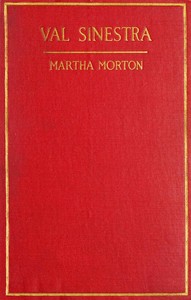
For Val Sinestra — Story, Setting & Ideas, the stored edition analysis reports 66,448 words, 4 hr 49 min estimated reading time, and 11 detected text sections.
The text analysis averages about 13.1 words per sentence, while the detected sections provide another way to judge how the source is divided.
Project Gutenberg metadata also associates the work with “Triangles (Interpersonal relations) -- Fiction,” connecting these edition facts with the source record’s subject description.
Explore this collection
These alternatives are selected using recorded categories and estimated reading time.
About 290 minutes
England London Nineteenth Century Fiction
66,497 recorded words. 1 minutes difference from this book's estimate.
View Gutenberg source #62967About 292 minutes
England London Nineteenth Century Fiction
67,008 recorded words. 3 minutes difference from this book's estimate.
View Gutenberg source #65227About 293 minutes
England London Nineteenth Century Fiction
67,289 recorded words. 4 minutes difference from this book's estimate.
View Gutenberg source #59319Search stored excerpts and compare books → Choose by your preferences →
Choices use stored catalog measurements. Estimates vary with reading speed. A shared category is a catalog label, not a claim that two books have the same argument or literary quality.
Search reads excerpt text stored with this catalog and links to its associated Gutenberg record. The connection is stored in the site database; this tool does not recheck that every excerpt is word-for-word identical to that external record. Excerpt search does not cover every chapter and does not verify historical publication dates.
Catalog snapshot checked: 2026-09-26. Coverage: 98 public books, 98 available source excerpts.
Calculated from edition completeness, EPUB availability, text structure and catalogue metadata. Not a user rating.
Total of 100 points, scaled to a 2.5-5.0 range. Editions with an empty description or a missing EPUB file are not scored.
Public-domain source text
The source text is kept in the dedicated reader, separate from this catalogue record and its commentary.
Martha Morton's Val Sinestra opens with a striking epigraph in a 'Romash Dialect' that frames the valley as a place of both 'Melody' and 'Madness.' The novel then introduces Julie Gonzola, a young woman whose 'emotional exaggeration' and 'ecstatic self-oblivion' at a convent hint at a turbulent inner life. The catalog subjects list 'Triangles (Interpersonal relations)' and 'New York (N.Y.) -- Social life and customs,' but the excerpts show that the story's early focus is less on romantic rivalry and more on Julie's psychological intensity and her mother's struggle to instill 'the dignity of her wealth.'
The excerpts devote considerable attention to Julie Gonzola's upbringing and temperament. She is described as 'a mystery to her friends, her mother, herself,' with 'a nature of unexpected impulses, tragic possibilities, baffling secrets.' Her mother, a devout Catholic widow, sends her to the Convent of the Sacred Heart, where Julie is 'docile and receptive' but prone to fits of hysteria. The narrative emphasizes her difference from a carefree friend, Maud Ailsworth, who 'romped all day long in the street with the boys.' This contrast suggests that Julie's emotional volatility is central to her character, though the excerpts do not reveal how it drives the plot.
Another thread in the excerpts involves a man named Martin, who confronts a business partner, Waldbridge, about a failing firm. Martin declares he is 'out of it' and proposes a radical restructuring: turning the business into a company where every employee gets a share. Waldbridge is stunned, wondering if Martin is mad. Martin then leaves New York, taking only a dress suit case and an old box containing his grandfather's belongings—mountain boots, a felt hat with a green feather, and a photograph labeled 'Val Sinestra.' The financial crisis is depicted with visceral language: 'gorging money at that rate; we’d have to vomit it up sometime.' This scene suggests that the novel intertwines personal and economic upheaval.
The title Val Sinestra refers to a Swiss valley that appears in a photograph among Martin's grandfather's effects. Martin is 'fascinated' by the mountain in the picture and decides to take the box with him to Switzerland. The epigraph—'Who knows Thee, “Val Sinestra,” / — Thy Melody—Thy Madness?'—positions the valley as a symbol of both beauty and danger. The excerpts do not clarify whether Julie or other characters also journey there, but the valley's name recurs as a destination and a mystery. The catalog subject 'Triangles (Interpersonal relations)' may eventually involve this setting, but the excerpts only show Martin's solitary departure.
Readers should note that the excerpts cover only the novel's opening and a middle scene; the full 66,448-word text likely develops Julie's story and Martin's Swiss journey further. The catalog subjects emphasize New York social customs and romantic triangles, but the early chapters foreground psychological intensity and financial crisis. Pay attention to how the 'Val Sinestra' motif recurs and whether it ultimately unifies the disparate threads of inheritance, escape, and emotional turmoil.
Your answers remain private and are stored only in this browser.









