
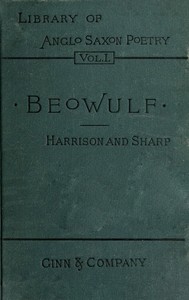
I. Beowulf: an Anglo-Saxon poem. II. The fight at Finnsburh: a fragment.
Let's be honest, the 'Unknown' author credit doesn't exactly build hype. But this book contains two foundational pieces of English storytelling. Forget everything you think you know about 'old' literature. This is immediate, bloody, and surprisingly human.
The Story
The main event is Beowulf. It’s in three big acts. First, the young hero Beowulf arrives at King Hrothgar's mead-hall, Heorot, which is being ripped apart by the monster Grendel. Beowulf promises to fight it without weapons—mano a monster—and he does, in a terrifying, bare-knuckle brawl. Just when you think it's over, Grendel's mother seeks revenge, leading Beowulf into a haunted, underwater lair for another brutal fight. The final act jumps ahead fifty years. Beowulf is now an old king, and he must face his last enemy: a dragon. This isn't a clean, heroic end. It's messy, costly, and leaves you thinking about the weight of a legacy.
The Fight at Finnsburh is a different beast. It's just a fragment, a single, intense scene. Warriors are ambushed in a hall. The door is held against attackers. It's all flashing swords, shouted boasts, and sudden death. You're thrown right into the middle of a feud, and just as quickly, the text cuts off. It's frustrating and utterly compelling.
Why You Should Read It
I love this because it strips heroism down to its bones. Beowulf isn't perfect. He's boastful, he ages, and his victories come with a price. The world feels real and dangerous. The loyalty between warriors, the grief of a king, the fear of the dark forest—these emotions haven't changed. Reading it in this dual format is great. You get the full, epic sweep of Beowulf's life, and then the raw, unfiltered snapshot of battle from Finnsburh. It shows you the whole range of what these stories could do.
Final Verdict
This is for the curious reader, not the scholar. It's perfect for fantasy fans who want to see the roots of their favorite tropes, for anyone who loves a straightforward tale of good vs. evil with layers of complexity, or for someone who just wants a story with real stakes. Don't approach it like homework. Read it out loud, feel the rhythm, and let yourself be pulled into the mead-hall. You might be surprised by how much this ancient poem has to say.
This content is free to share and distribute. It is available for public use and education.
Edward Taylor
2 months agoVery helpful, thanks.
David Wright
1 year agoUsed this for my thesis, incredibly useful.
Lucas Hill
1 year agoThe index links actually work, which is rare!
Sarah Wilson
2 months agoA bit long but worth it.
Patricia Hernandez
2 years agoJust what I was looking for.