About 382 minutes
Buffalo Bill's Bold Play; Or, The Tiger of the Hills — A Reader’s Guide
Adventure Picaresque Fiction
87,682 recorded words. 21 minutes difference from this book's estimate.
View Gutenberg source #63705
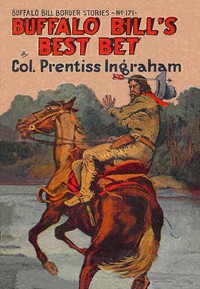
The source record for Buffalo Bill's Best Bet; Or, A Sure Thing Well Won — Inside the Classic measures this digital text at 82,959 words, 6 hr 1 min estimated reading time, and 60 detected text sections.
The text analysis averages about 20.2 words per sentence, while the detected sections provide another way to judge how the source is divided.
Project Gutenberg metadata also associates the work with “Dime novels,” connecting these edition facts with the source record’s subject description.
Explore this collection
These alternatives are selected using recorded categories and estimated reading time.
About 382 minutes
Adventure Picaresque Fiction
87,682 recorded words. 21 minutes difference from this book's estimate.
View Gutenberg source #63705About 383 minutes
Adventure Picaresque Fiction
87,993 recorded words. 22 minutes difference from this book's estimate.
View Gutenberg source #63176About 387 minutes
Adventure Picaresque Fiction
88,933 recorded words. 26 minutes difference from this book's estimate.
View Gutenberg source #62057Search stored excerpts and compare books → Choose by your preferences →
Choices use stored catalog measurements. Estimates vary with reading speed. A shared category is a catalog label, not a claim that two books have the same argument or literary quality.
Search reads excerpt text stored with this catalog and links to its associated Gutenberg record. The connection is stored in the site database; this tool does not recheck that every excerpt is word-for-word identical to that external record. Excerpt search does not cover every chapter and does not verify historical publication dates.
Catalog snapshot checked: 2026-09-26. Coverage: 98 public books, 98 available source excerpts.
Calculated from edition completeness, EPUB availability, text structure and catalogue metadata. Not a user rating.
Total of 100 points, scaled to a 2.5-5.0 range. Editions with an empty description or a missing EPUB file are not scored.
Public-domain source text
The source text is kept in the dedicated reader, separate from this catalogue record and its commentary.
From its opening pages, Buffalo Bill's Best Bet establishes a world where personal loyalty and communal survival are constantly tested. The narrative wastes no time in introducing a death—that of a woman named Grace, who dies by her own hand before the eyes of Red Hand, a man who once loved her. Buffalo Bill himself digs her grave and urges his grieving comrade to move on, for “many lives are dependent upon you.” This early scene sets a tone of urgent pragmatism shadowed by unresolved pasts.
The novel’s structure, with fifty-six short chapters, reflects the rapid-fire pacing typical of dime literature. Yet within that pace, Ingraham lingers on moments of ritual—the burial, the blanket shroud, the “rude coffin” of poles—that give weight to otherwise swift action. The setting, the “Haunted Valley of the Black Hills,” is both a geographical refuge and a psychological space where secrets surface.
The burial of Grace is more than a plot device; it is the novel’s most sustained piece of descriptive writing in the excerpts. Ingraham devotes several paragraphs to the physical acts: Buffalo Bill digs the grave, lines it with poles, and “most tenderly” throws in the soil. Red Hand wraps the body in his own blanket, then stands “with uncovered head and folded arms.” The scene is heavy with ritualized grief, yet it also cements the partnership between the two men. Red Hand’s gratitude is immediate: “I have much to thank you for.” The grave becomes a shared secret, a place that will later be called “sacred from intrusion.” This burial binds the scout and the chief together in a way that dialogue alone could not. It also introduces a pattern of characters being defined by what they do for the dead—a motif that may recur as the story unfolds.
The “Haunted Valley of the Black Hills” is presented as a place of safety precisely because it is feared. Buffalo Bill declares that “no Indian of the Sioux tribe, or outlaw, either, will ever penetrate into these wilds.” The valley’s reputation as haunted is a tactical asset. Yet the narrative undercuts that claim immediately: Red Hand replies, “We know now how it was haunted and why.” The mystery of the haunting is tied to Grace’s death, and perhaps to other events not fully revealed in the excerpts. The valley thus functions on two levels: as a practical stronghold for women and children during an expected Indian attack, and as a symbolic space where hidden truths are confronted. Ingraham uses the setting to compress action and revelation, making the landscape itself a character that holds the past.
The excerpts reveal a web of withheld information. Red Hand promises to tell Buffalo Bill “the story of my life, in all its cruelty and sorrow; but not now.” He insists his hand is not stained with Grace’s father’s blood, yet admits “there is a stain upon it.” Buffalo Bill, for his part, “still trusted Red Hand, though there were many things he could not yet understand.” This dynamic of partial disclosure drives the narrative forward. The reader is given enough to sense that Red Hand’s past involves violence and loss, but not enough to judge him. Meanwhile, practical decisions—moving the camp, guarding the valley—are made against a backdrop of incomplete knowledge. Ingraham balances action with withheld exposition, creating a tension that propels the dime novel’s rapid chapters.
Readers approaching Buffalo Bill's Best Bet should attend to the way Ingraham uses small, concrete details—a blanket used as a shroud, a grave lined with poles—to anchor melodramatic events. The novel’s brevity of chapter length does not preclude moments of genuine pathos. Pay particular attention to how characters’ pasts are hinted at rather than explained; the gaps are part of the design. The Haunted Valley, in particular, rewards close reading as a site where the story’s emotional and tactical threads converge.
The rain blurred the Black Hills into watercolor, and inside that 1914 world of Buffalo Bill’s warnings, I felt the weight of histories not fully told. That haunted valley lingered, whispering about other American shadows. Later, I found myself reaching for something quieter, more uncomfortable—Harold the Klansman — Reading Companion—almost as if the rain had pushed the two books together on my shelf.
Your answers remain private and are stored only in this browser.









