About 383 minutes
Buffalo Bill's Girl Pard; Or, Dauntless Dell's Daring — Edition Insights
Adventure Picaresque Fiction
87,993 recorded words. 4 minutes difference from this book's estimate.
View Gutenberg source #63176
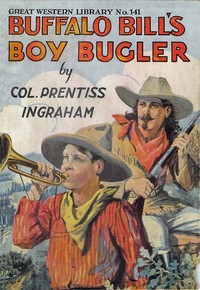
The source record for Buffalo Bill's Boy Bugler; Or, The Last of the Indian Ring — Reading Notes measures this digital text at 88,933 words, 6 hr 27 min estimated reading time, and 51 detected text sections.
The text analysis averages about 19.0 words per sentence, while the detected sections provide another way to judge how the source is divided.
Project Gutenberg metadata also associates the work with “Dime novels,” connecting these edition facts with the source record’s subject description.
Explore this collection
These alternatives are selected using recorded categories and estimated reading time.
About 383 minutes
Adventure Picaresque Fiction
87,993 recorded words. 4 minutes difference from this book's estimate.
View Gutenberg source #63176About 392 minutes
Adventure Picaresque Fiction
90,029 recorded words. 5 minutes difference from this book's estimate.
View Gutenberg source #62479About 382 minutes
Adventure Picaresque Fiction
87,682 recorded words. 5 minutes difference from this book's estimate.
View Gutenberg source #63705Search stored excerpts and compare books → Choose by your preferences →
Choices use stored catalog measurements. Estimates vary with reading speed. A shared category is a catalog label, not a claim that two books have the same argument or literary quality.
Search reads excerpt text stored with this catalog and links to its associated Gutenberg record. The connection is stored in the site database; this tool does not recheck that every excerpt is word-for-word identical to that external record. Excerpt search does not cover every chapter and does not verify historical publication dates.
Catalog snapshot checked: 2026-09-26. Coverage: 98 public books, 98 available source excerpts.
Calculated from edition completeness, EPUB availability, text structure and catalogue metadata. Not a user rating.
Total of 100 points, scaled to a 2.5-5.0 range. Editions with an empty description or a missing EPUB file are not scored.
Public-domain source text
The source text is kept in the dedicated reader, separate from this catalogue record and its commentary.
Prentiss Ingraham's Buffalo Bill's Boy Bugler; Or, The Last of the Indian Ring (1909) opens with a dedication that roots the story in the real-life friendship between Colonel William F. Cody and the author. The novel's language, however, quickly departs from biographical fact into a stylized frontier vernacular. In one excerpt, Wild Bill Hickok orchestrates a prank on a group of mounted Indians by imitating a snarling beast—an act that prompts the trapper Nomad to unleash a torrent of invented slang: “caterwaulin’ lunkumsluices” and “snarlin’ molwallopuses.” This moment reveals Ingraham's deliberate construction of a comic, exaggerated Western voice.
Ingraham distinguishes his characters through distinct speech patterns. Nomad's dialogue is thick with nonstandard spellings and compound neologisms: “sidehill lounger,” “plumb wust,” and “tarnal kihootin’.” These terms are not recorded in standard frontier lexicons; they appear to be Ingraham's inventions, designed to signal rustic authenticity while providing comic relief. In contrast, Hickok speaks in clipped, practical sentences: “To think was to act with Hickok.” The narrator's own voice remains formal and omniscient, creating a layered effect where the reader observes the action through both elevated prose and earthy dialect.
When Hickok frightens the ponies, the narrator describes the sound as “an uncanny cross between a bark and a growl” that could have been made by “a half dozen catamounts and a grizzly or two thrown in.” The ponies react with a “mad dash,” and the scene culminates in a chaotic stampede. Ingraham repeatedly likens human actions to animal behavior: Hickok “launched himself on hands and feet,” and Nomad later claims he thought a “sidehill lounger” with “feet ez big ez bundles o’ hay” had come to “gobble ther hull pot an’ kittle.” This animalistic framing undercuts the danger of the Indian encounter, turning a potential ambush into a farcical chase.
The excerpt builds suspense through careful pacing. Hickok observes the mounted men from a distance, weighs his options, and then devises a plan. The narration shifts between his internal thoughts (“Perhaps those fellows think they are going to sit there, like a turtle on a log”) and external action. The payoff is a sudden, noisy disruption followed by a quick reunion with the “pards.” Ingraham uses the signal—a call answered from the ravine—as a narrative device to reestablish group cohesion after the chaos. The scene ends with Nomad's mock outrage, which defuses tension and reinforces the camaraderie among the scouts.
The prefatory note describes how Ingraham and Ned Buntline “used to forgather in the office of Francis S. Smith” and began writing Buffalo Bill stories for Street & Smith. This meta-textual framing acknowledges the commercial origins of the dime novel. The dedication also sketches Cody's biography—his service as a pony-express rider, scout, and buffalo hunter—but the fiction that follows does not adhere strictly to those facts. Instead, Ingraham freely invents episodes like Hickok's prank, blending historical names with tall-tale humor. The gap between the earnest biographical sketch and the playful narrative suggests that Ingraham viewed the novel as entertainment first, historical record second.
Ingraham peppers the text with terms like “pards” (partners), “feather pates” (Indians), and “mustangs.” Nomad's outburst includes words that seem coined for the moment: “lunkumsluices” and “molwallopuses.” These neologisms have no clear etymology; they function as nonsense words that heighten the comic effect. The author also uses dialectal contractions (“hyar,” “ther,” “ergin”) to mark Nomad as a backwoods character. This linguistic inventiveness is a hallmark of the dime novel genre, where authenticity is less important than creating a vivid, memorable voice.
Readers attentive to Ingraham's word choices will find a writer who balances formulaic adventure with bursts of linguistic play. The prank scene, with its animal sounds and invented curses, exemplifies how dime novels could blend suspense with slapstick. Rather than expecting historical accuracy, approach this text as a performance of frontier mythology—one where the author's real skill lies in orchestrating dialogue, dialect, and comic timing.
That old dime novel stayed with me because of its rough voice, the slang and animal grunts that felt almost alive. It reminded me how stories cling through their smallest textures. The same quiet ache surfaced later, oddly, in Christmas Stories — A Closer Reading—not the holiday warmth, but the way detail can hold a whole forgotten world gently in place. I keep turning it over.
Answer a few questions and save a private reflection on this device.









