
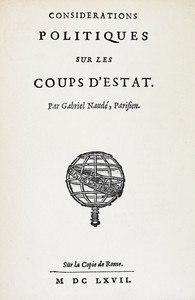
Considerations politiques sur les coups d'estat by Gabriel Naudé
Let's be clear: this isn't a novel with a plot. It's more like finding a secret playbook. Written in 1639 by Gabriel Naudé, a scholar and librarian for powerful cardinals, Considerations politiques sur les coups d'état is his attempt to scientifically study the most drastic act in politics: the sudden, violent overthrow of a government.
The Story
Naudé looks at history like a detective solving a crime. He gathers examples of coups from Roman emperors to modern princes. His goal? To find the common rules. He argues that sometimes, for the long-term stability of a state, a leader must take one shocking, extraordinary, and often ruthless action—a 'coup d'état.' He walks through the steps: knowing exactly when to strike, controlling public perception, securing key allies, and using secrecy and surprise. The 'story' is his logical, step-by-step breakdown of how political earthquakes are engineered, stripping away moralizing to look at the cold mechanics of power.
Why You Should Read It
What gripped me wasn't agreement, but the sheer audacity of his clarity. Naudé isn't writing a manifesto; he's writing a dispassionate analysis. Reading it feels like looking at an X-ray of politics. It makes you question everything you assume about how leaders stay in power and how change happens. The most fascinating part is his voice—a Renaissance man applying reason to the most unreasonable acts. It’s a stark reminder that the struggles for power we see today have a very long, and very calculated, history.
Final Verdict
This is not a beach read. It's for the intellectually curious—the history buff who wants more than dates and battles, the political junkie interested in the raw theory of power, or anyone who loves primary sources that challenge modern perspectives. If you enjoyed the realpolitik of Machiavelli's The Prince, this is its more focused, more shocking cousin. Be prepared: it’s a challenging, sometimes uncomfortable book that will change how you watch the news. A fascinating glimpse into the mind of the 17th century, and perhaps, into the timeless rules of the game.
This text is dedicated to the public domain. It is available for public use and education.
Jennifer Rodriguez
8 months agoHaving read the author's previous works, the logic behind each conclusion is easy to follow and verify. I'll be recommending this to my students and colleagues alike.
Mark Robinson
1 year agoBeautifully written.
Donna Lopez
1 year agoI had low expectations initially, however the clarity of the writing makes this accessible. A true masterpiece.
Elijah Sanchez
1 year agoVery interesting perspective.
Joseph Taylor
1 year agoThe citations provided are a goldmine for further academic study.